
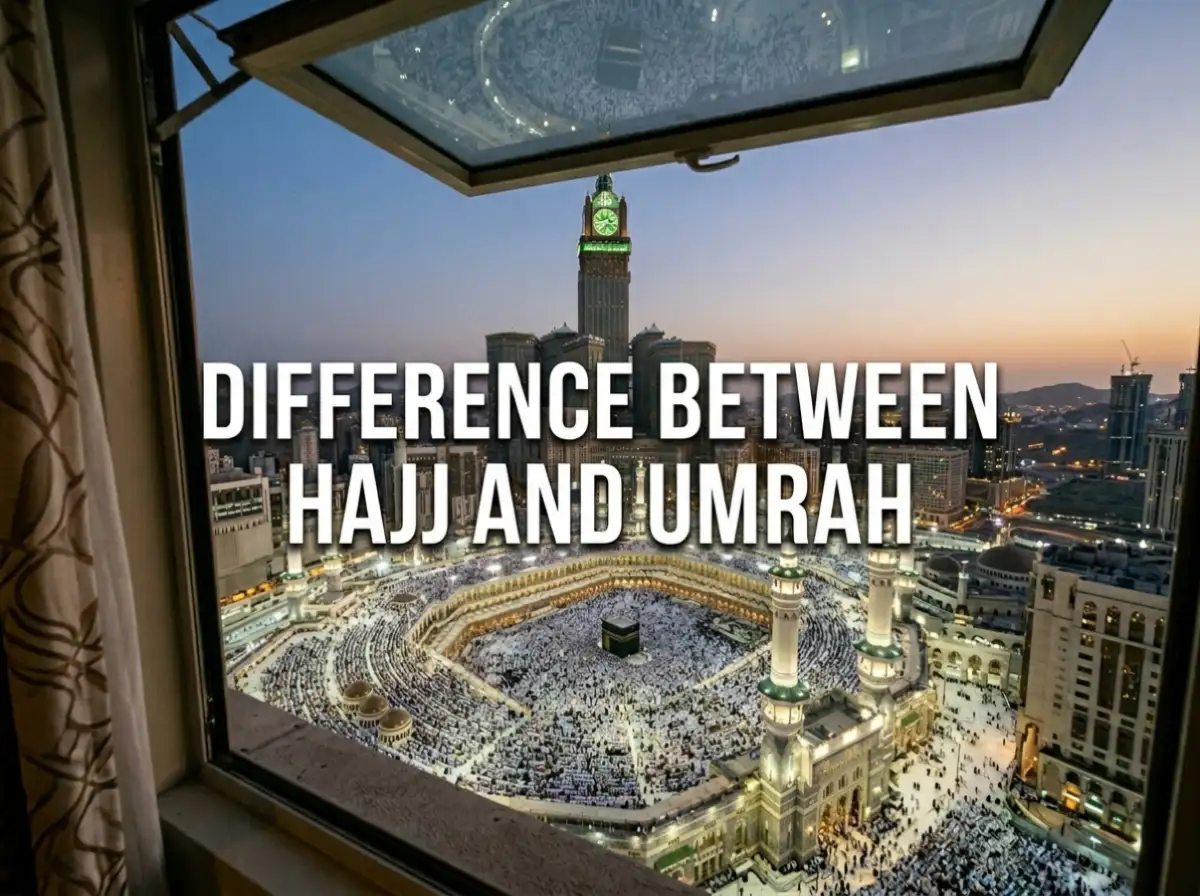

Hajj is one of the five pillars of Islam. It is obligatory once in a lifetime for every Muslim who is physically and financially able. Umrah is voluntary, shorter, and can be performed at almost any point in the year. One is a binding duty with specific days you cannot miss. The other is an act of worship you can return to again and again, on your own schedule, from a few hundred pounds.
What Is Hajj?
Hajj is performed during the first thirteen days of Dhul Hijjah, the final month of the Islamic lunar calendar, with the core rites falling between the 8th and 13th. It is one of the largest human gatherings on earth, drawing between two and three million pilgrims to Saudi Arabia at the same time.
The rituals span five to six full days and take you across multiple locations outside Makkah itself. You enter Ihram at the Miqat, perform Tawaf around the Kaaba, and then travel to the plain of Arafat on the 9th of Dhul Hijjah. Standing at Arafat is the single most important moment in Hajj. Miss it, and the entire pilgrimage is invalid, regardless of everything else you completed.
After Arafat, you spend a night at Muzdalifah under open skies (this part is often described by pilgrims as unexpectedly peaceful, despite the sheer number of people around you), collect pebbles, and then travel to Mina to stone the three Jamarat pillars. An animal sacrifice follows, hair is shaved or trimmed, and a final Tawaf brings the pilgrimage to its close.
For UK Muslims, Hajj cannot be done independently. All British pilgrims must travel through a licensed tour operator, and places are allocated through a government-regulated quota between the UK and Saudi Arabia. This means limited spots, early registration, and no flexibility on travel dates.
Hajj 2026 falls in late May, which puts it squarely in the Saudi summer heat. That is worth knowing long before you book.
What Is Umrah?
Umrah is sometimes called the “lesser pilgrimage,” but that label can give the wrong impression. It is a profound, emotionally powerful act of worship that many Muslims describe as life-changing, and the reward mentioned in hadith literature is significant.
The rituals are simpler and take place entirely within Makkah. You enter Ihram, perform Tawaf (seven circuits around the Kaaba, moving counter-clockwise), walk the Sa’i between the hills of Safa and Marwah seven times, and then shave or trim your hair to exit Ihram. Most pilgrims complete the full ritual in three to six hours.
You can perform Umrah at almost any time of year. That flexibility is what makes it so practical for UK Muslims managing school term dates, annual leave allowances, or family travel budgets. You can go in January, during the Easter holidays, in the weeks of Ramadan, or over a long weekend in October. The door is almost always open.
Umrah does not fulfil the obligation of Hajj. Even if you perform it every year for twenty years, if Hajj is due on you and you have the means, that obligation remains. The two are not substitutes for each other.
Both pilgrimages begin at the same place and share the same spirit of devotion. But the differences in obligation, timing, duration, and logistics are significant enough that every Muslim planning a trip to the holy cities needs to understand them clearly before making any decisions.
How the rituals actually differ
Both pilgrimages share the Tawaf and the Sa’i, and both begin with entering Ihram at the Miqat. But Hajj layers on a full set of rituals across multiple days and locations that Umrah simply does not include.
Umrah is focused entirely within Makkah. You enter Ihram, circle the Kaaba seven times in Tawaf, walk the Sa’i between Safa and Marwah seven times, then shave or trim your hair to exit Ihram. That is the complete sequence. Most pilgrims finish in three to six hours.
Hajj includes all of that and then goes much further. After Tawaf, you travel to the plain of Arafat on the 9th of Dhul Hijjah and stand in supplication from midday until sunset. This moment is the pillar of Hajj. Miss it for any reason and the entire pilgrimage is invalid, regardless of everything else you completed. You then spend the night at Muzdalifah under open skies (yes, this means sleeping outdoors on the ground), travel to Mina to stone the three Jamarat pillars on three separate days, and perform an animal sacrifice before a final Tawaf brings everything to a close.
The difference in scale is significant. Umrah is a few hours. Hajj is five to six full days across four locations.
Timing: What UK Muslims actually need to plan around
Hajj 2026 falls in late May. That places it in peak Saudi summer heat, directly during the school half-term window, and with a fixed, non-negotiable date range that cannot shift. If you are considering Hajj this year, registration with a licensed UK operator should already be underway. Places allocated under the UK quota system sell out months in advance.
Umrah has none of that pressure. You can book it around school term dates, annual leave, or simply whenever feels right. The February half-term and Easter windows are genuinely practical options for UK families, with regular direct flights from Manchester, London Heathrow, and Birmingham to Jeddah or Madinah running at roughly six to seven hours.
Performing Umrah during Ramadan carries a specific narration from the Prophet (peace be upon him) describing its reward as equivalent to Hajj. Scholars are unanimous, though, that it does not remove the Hajj obligation if Hajj is due on you. The reward may be parallel. The duty is not.
What Hajj and Umrah actually costs in 2026
The cost gap between the two is real, and understanding why it exists helps you plan more honestly.
Hajj packages from the UK in 2026 start at around £4,500 for economy options and can reach over £12,000 for premium packages. The range reflects accommodation grade, proximity to the Masjid al-Haram, and whether the package includes a non-shifting hotel (you stay in one place throughout) or a shifting arrangement where you move between Makkah and Madinah. You cannot strip out elements to reduce cost the way you might with a regular holiday. The logistics are regulated jointly by UK operators and the Saudi government, and the cost reflects that.
Umrah from the UK is far more accessible. All-inclusive 7-night packages with flights start from around £675 to £695. A solid mid-range 10-day package covering flights, 4-star accommodation, transport, visa, and breakfast typically runs between £1,100 and £1,300. Ramadan packages and 5-star options push closer to £1,500 to £2,500.
The cost gap comes down to scale. Hajj means more days, regulated Mina camp accommodation, multi-site transport, and high global demand competing for a limited quota. Umrah has none of those layers.
Physical Demands: Know before you book
This is the part most first-timers underestimate, particularly for Hajj.
Over five to six days, you will walk upwards of 20 kilometres in Saudi summer heat that regularly hits 40 degrees or above in late May. Sleeping at Muzdalifah is outdoors. Navigating the Jamarat during stoning days means moving through some of the densest crowds on earth. If you are not physically prepared, Hajj will be far harder than it needs to be. Months of consistent walking and building stamina before you travel make a real, measurable difference.
Umrah is physically engaging but manageable. The Tawaf covers roughly 2 to 3 kilometres and the Sa’i adds another 3.5 kilometres. You complete it at your own pace, in a single session, without outdoor sleeping or multi-day exertion.
A few things worth knowing before you book either:
- Elderly pilgrims and those with mobility conditions can use wheelchairs for the Tawaf and Sa’i. UK operators arrange this routinely for Umrah.
- Anyone with a heart condition, diabetes, or a condition affected by heat should speak to their GP before booking Hajj. The physical environment is demanding in ways a standard trip abroad is not.
- Children can perform Umrah. Hajj is valid for children but the obligation itself only falls on adults who have the means to fulfil it.
The misconception that catches people out
We hear this one regularly: “I have done Umrah three times, so I am covered for Hajj, right?”
Wrong, and this matters. Umrah does not fulfil the obligation of Hajj under any circumstances. Even performing Umrah during Ramadan, which carries an elevated reward in narration, does not remove the duty of Hajj if you are financially and physically able to perform it. The two acts of worship are separate in their nature, their obligation, and their reward. No number of Umrahs closes the Hajj account.
The obligation of Hajj falls on a Muslim once in their lifetime when two conditions are met: physical ability and financial ability. If both apply to you and you have not yet performed Hajj, it is worth taking that seriously rather than postponing indefinitely.
Mahram rules for Women travelling from the UK
Rules differ between the two pilgrimages, and they have shifted in recent years with changes to Saudi policy.
For Hajj, most traditional scholarly positions require a mahram (a male guardian, such as a husband, father, or brother) to accompany a woman. Some schools of thought permit exceptions within organised groups, but this varies, and UK operators will advise on current rulings before you book.
For Umrah, the rules are more flexible. Women over the age of 18 are generally permitted to travel without a mahram when booking through an approved group operator. Saudi Arabia updated its Umrah entry requirements in recent years to reflect this, and most ATOL-licensed UK agents handle women travelling in organised groups without a mahram as a standard booking. Always confirm the current rules directly with your operator before purchasing, as Saudi regulations do change from season to season.
What to do next, based on your situation
If you have never been to Makkah, Umrah is almost always the right first step. It is accessible financially, manageable physically, flexible in timing, and spiritually transformative. Many UK Muslims describe their first Umrah as the experience that made Hajj feel real and urgent rather than abstract.
If Hajj is due on you and you have the means, start the process now. Research ATOL-licensed operators, understand the UK quota system, and register early. Hajj 2026 places from the UK are already filling, and waiting until next year simply delays a duty that is already incumbent on you.
If you are undecided about timing, consider Umrah during Ramadan this year as a stepping stone. It costs less than Hajj, takes less time off work, and gives you a lived experience of the holy cities that will shape how you prepare for Hajj when the time comes.
————————
Related Articles:
- Best Times to Make Dua During Hajj and Umrah
- Top 12 Must-See Places in Makkah
- Ihram Guide for UK Muslims
- How to Spend the Day of Arafah
- Umrah Visa 2026 for UK Residents – Fees, Eligibility & Application Process
- Types of Umrah Packages – Which One Is Right for You
- How to Prevent Heatstroke During Umrah and Hajj
- How to Perform Umrah – Step by Step Guide for UK Muslims
- What to Know Before Booking an Umrah Package from UK
- Roza e Rasool Visiting Time – Latest Rules for Men & Women
- The Main Gates of Masjid Al Haram
- How Many Umrahs Can Be Performed in One Day
- Hajj Mubarak Gifts
- Best Hajj Essential Apps
- Common Mistakes During Hajj
- Miqat points for Umrah from the UK
- Can You Perform Umrah for the Deceased?
- How Much Does an Umrah Package Cost from the UK
- Top 10 Umrah Mubarak Gift Ideas to Welcome Loved Ones Home
- Best Month to Go for Umrah 2026 from the UK
- How to book a Rawdah appointment