
What You Actually Need to Know First
UK Muslims going for Hajj in 2027 must book through a Saudi Ministry-approved operator, register on the official Nusuk Hajj portal (nusuk.sa), secure a Hajj visa, and complete required vaccinations before travelling to Makkah for the five-day pilgrimage. The full trip from the UK runs between 14 and 21 days depending on your package.
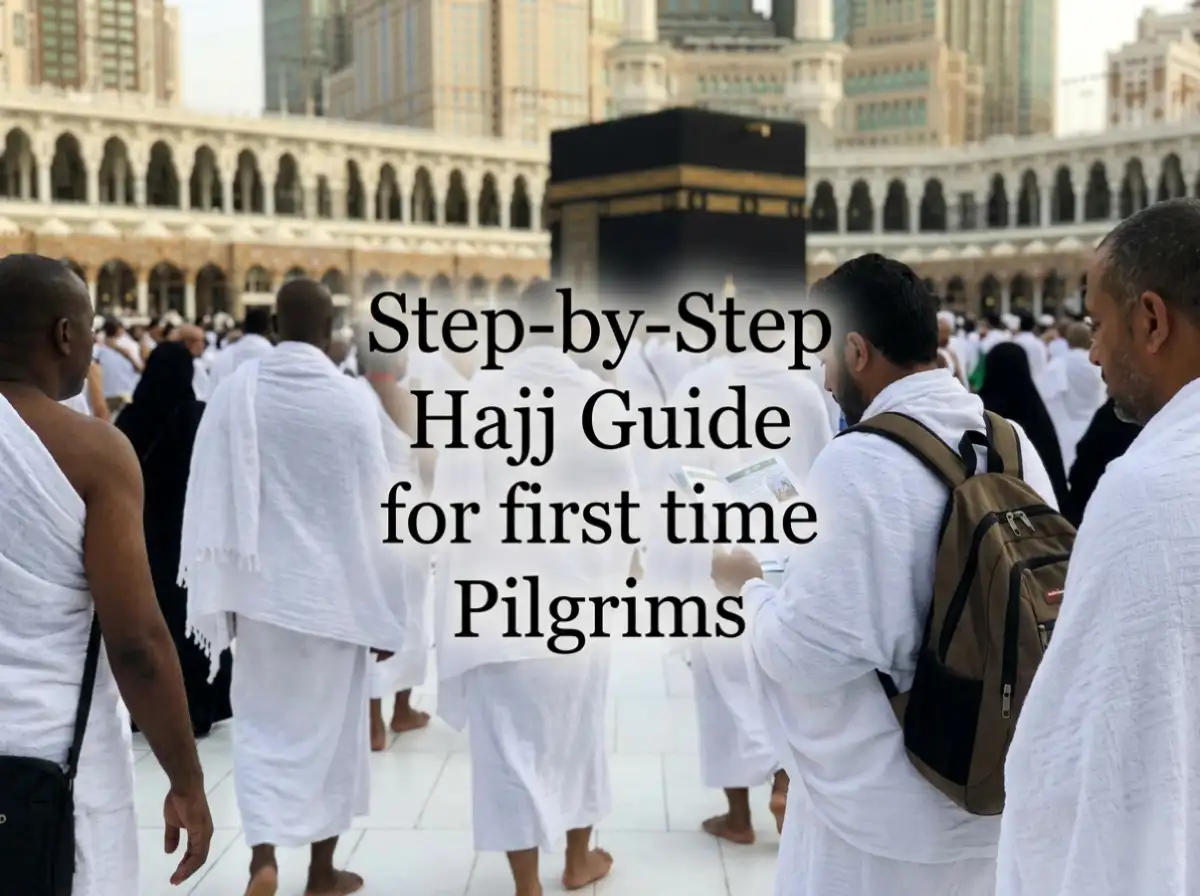
Most people worry about the rituals. But ask anyone who has been, and they will tell you the hard part was the weeks before they left. The visa confusion, the Nusuk registration, the vaccination timing, the question of whether their operator was even legitimate. You will find every detail in this Step-by-Step Hajj Guide for first time UK Pilgrims
When Is Hajj 2027?
Hajj 2027 is expected to begin on the evening of 14 May 2027. The key day, Yawm al-Arafah (9 Dhul Hijjah), falls on 19 May 2027. Saudi authorities confirm the exact dates by moon sighting, so watch for the official announcement as the date approaches.
Booking Your Hajj Package from the UK
You cannot book Hajj like a regular holiday. The Saudi government controls all access, and UK pilgrims must use an approved operator.
Here is the catch. Not every company advertising Hajj packages online is legitimate. CBHUK (cbhuk.org) publishes a regularly updated public warning urging British Muslims to book only through the official Nusuk Hajj portal and approved operators. Fraudulent bookings have left UK pilgrims stranded and out of pocket in previous years.
What to look for when choosing a package:
- Operator must be listed as approved through the Nusuk Hajj system
- Economy packages typically cover flights, accommodation in Makkah and Madinah, and ground transport
- Premium packages offer hotels closer to the Masjid al-Haram, which matters when you are praying five times a day on tired legs
- Most full packages from the UK in 2027 range from £6,500 to £16,000 per person depending on category and proximity to the Haram
At Ziyuf Al Rahman, we handle the entire booking process for UK families and guide you through every step so nothing falls through the gaps.
Registering on the Nusuk Hajj Portal
This step trips up a lot of first-timers. There are two different Nusuk platforms (the Nusuk app and the Nusuk Hajj website), and they are not the same thing. Hajj can only be booked through nusuk.sa, the website, not the app.
British citizens and those with indefinite leave to remain or a valid UKVI/eVisa account must book via Nusuk Hajj. Your operator will walk you through this, but knowing the process helps:
- Create your account on nusuk.sa using your passport details
- Choose your Hajj category (economy, standard, or premium)
- Upload your documents and complete payment through the portal
- Receive your Hajj permit, which is checked at every entry point around Makkah during the Hajj season
No permit means no access. Saudi authorities enforce this strictly.
Documents You Need to Prepare for Hajj
Get these sorted well before your departure. Missing even one can delay the whole process.
- Valid UK passport (minimum 6 months validity beyond your travel dates)
- Hajj visa (your approved operator submits this on your behalf)
- Mahram documentation for women travelling with a husband or male guardian (women travelling through approved group operators have seen relaxed conditions in recent years, but check the current rules with your operator)
- Vaccination certificates (see below)
- White-background passport photos
- Travel insurance documentation
Keep both physical copies and digital backups. Phones get lost. Documents in your email do not.
Vaccinations: Do Not Leave This Late
This is the one area where UK pilgrims consistently run out of time. Some vaccines need to be administered weeks before departure, and GP appointments in spring fill up fast.
Mandatory vaccinations for Hajj 2027:
- Meningococcal ACWY vaccine, required at least 10 days before arrival in Saudi Arabia
- COVID-19 vaccination (Saudi requirements are updated regularly, confirm the current rules before you travel)
- Yellow Fever vaccine if you are travelling from or transiting through an endemic country
Strongly recommended (not always mandatory, but widely advised by NHS and travel health specialists):
- Seasonal influenza vaccine
- Hepatitis A and B
- Typhoid
- Pneumococcal vaccine (particularly important for older pilgrims or those managing chronic health conditions)
Book your vaccinations at least 6 to 8 weeks before your departure date. Your GP, or a dedicated travel health clinic, can advise on your specific needs. If you take prescription medicines, be aware that Saudi Arabia requires an SFDA permit for controlled medications brought into the country. Check the current requirements at cbhuk.org.
A Word Before We Get to the Rituals
The logistics above are the foundation. Without them, you do not get through the door. But Hajj is not a logistics exercise. It is the fifth pillar of Islam and one of the most spiritually transformative experiences a Muslim can have in their lifetime.
Allah says in the Quran:
Wa atimmul-Hajja wal-‘Umrata lillah
“And complete the Hajj and Umrah for the sake of Allah.”
(Surah Al-Baqarah, 2:196)
Go in prepared and go in present. The next section covers exactly how the five days of Hajj unfold, step by step.
The Three Types of Hajj
Before you enter ihram, you need to know which type of Hajj you are performing. There are three, and your operator will usually advise which is most practical for UK pilgrims.
Hajj al-Tamattu: Umrah first, then exit ihram, then re-enter ihram for Hajj. Most common for international pilgrims.
Hajj al-Qiran: Umrah and Hajj performed in one continuous ihram without exiting.
Hajj al-Ifrad: Hajj only, no Umrah. Less common for UK travellers.
Most UK pilgrims perform Hajj al-Tamattu. It gives you a break between Umrah and Hajj and is considered the most practical for those travelling from abroad.
Step-by-Step: How Hajj Is Performed
Entering Ihram at the Miqat
Ihram is the sacred state you enter before Hajj begins. It is both a physical act (wearing the white garments) and a spiritual intention.
Men wear two unstitched white cloths. Women wear modest, loose-fitting clothing covering everything except the face and hands. You cannot use perfumed soap, cut your hair or nails, or engage in marital relations while in ihram.
The Miqat is the designated boundary you must not cross without entering ihram. For UK pilgrims flying into Jeddah or Madinah, the relevant Miqat is Dhul Hulayfah (for those coming from Madinah) or Yalamlam (for those flying directly over). Your operator will confirm which applies to your flight path.
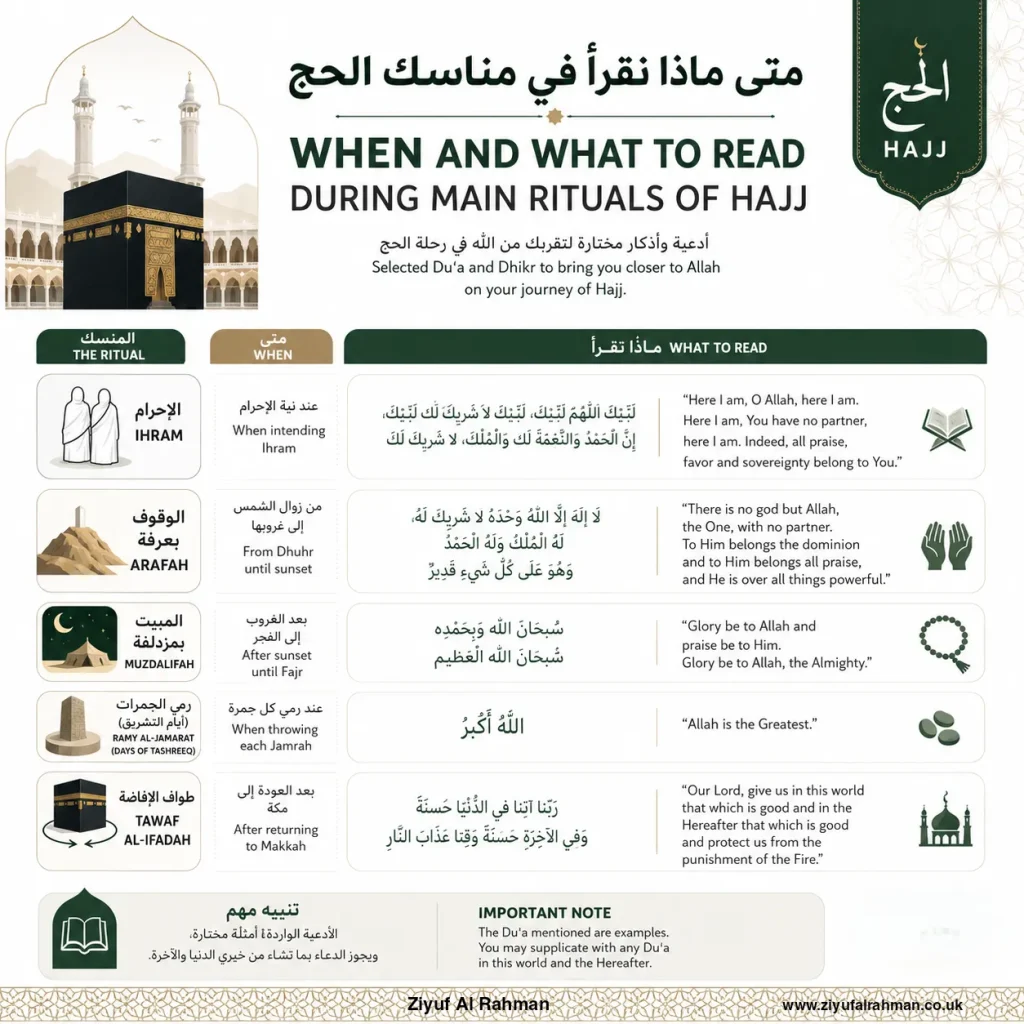
At the Miqat, you make the intention (niyyah) and recite the Talbiyah:
Labbayk Allahumma labbayk. Labbayk la shareeka laka labbayk. Innal-hamda wan-ni’mata laka wal-mulk. La shareeka lak.
“Here I am, O Allah, here I am. Here I am, You have no partner, here I am. Verily all praise, grace, and sovereignty belong to You. You have no partner.”
(Reported widely in Sahih Bukhari and Sahih Muslim)
Keep reciting the Talbiyah from this point until you begin stoning the Jamarat.
8 Dhul Hijjah: Yawm al-Tarwiyah (Day of Mina)
Travel to Mina on the morning of 8 Dhul Hijjah and spend the day and night there. You pray Dhuhr, Asr, Maghrib, Isha, and Fajr in Mina, shortening the prayers (qasr) but not combining them. This day is preparation. Rest here, make dhikr, and mentally settle into the spiritual rhythm of what comes next.
9 Dhul Hijjah: Yawm al-Arafah (The Most Important Day of Hajj)
This is the heart of Hajj. The Prophet (peace be upon him) said:
“Hajj is Arafah.”
(Reported in Sunan al-Nasa’i and Sunan Ibn Majah)
After Fajr in Mina, travel to the plain of Arafah and stay there from after midday (Dhuhr) until after sunset. At Arafah, the imam leads the Dhuhr and Asr prayers combined and shortened. Spend as much of this time as possible in sincere dua, dhikr, and asking for forgiveness.
A simple, widely recited dua on Arafah:
La ilaha illallahu wahdahu la shareeka lah, lahul-mulku wa lahul-hamd, wa Huwa ‘ala kulli shay’in Qadeer.
“There is no god but Allah alone, with no partner. To Him belongs all sovereignty and all praise, and He has power over all things.”
(Reported in Sunan al-Tirmidhi as the best dua on the Day of Arafah)
Do not leave Arafah before sunset. Leaving early invalidates your Hajj.
Night of 9 to 10 Dhul Hijjah: Muzdalifah
After sunset, travel to Muzdalifah. Pray Maghrib and Isha combined there and spend the night under the open sky. Collect 49 or 70 small pebbles (the size of a chickpea) here for the stoning of the Jamarat. Leave for Mina after Fajr. Those who are elderly, unwell, or travelling with young children may leave after midnight.
10 Dhul Hijjah: Yawm al-Nahr (Day of Sacrifice)
This is the busiest and most significant day. Four acts are performed, and while there is a recommended order, completing all four is what matters.
Rami al-Jamarat (Stoning): Stone the largest Jamarat (Jamarat al-Aqabah) with 7 pebbles, saying “Allahu Akbar” with each throw.
Hady (Animal Sacrifice): If performing Hajj al-Tamattu or Hajj al-Qiran, you must sacrifice an animal (or pay for one through your operator’s sacrificial service).
Halq or Taqsir (Hair): Men shave their heads completely (halq) or shorten their hair (taqsir). Women cut a fingertip-length from their hair. This act releases you from most ihram restrictions.
Tawaf al-Ifadah and Sa’i: Travel to the Masjid al-Haram and perform 7 circuits of the Kaaba (Tawaf al-Ifadah), then walk 7 times between Safa and Marwa (Sa’i). This completes the main rites of Hajj.
11, 12 (and optionally 13) Dhul Hijjah: The Days of Tashreeq in Mina
Return to Mina and spend these days (known as Ayyam al-Tashreeq) there. On each day, after Dhuhr, stone all three Jamarat in order (small, medium, large), with 7 pebbles each. That is 21 pebbles per day.
You may leave Mina on 12 Dhul Hijjah before sunset (the majority do this). Staying until 13 Dhul Hijjah is more virtuous.
Tawaf al-Wada (Farewell Tawaf)
Before leaving Makkah, perform 7 final circuits of the Kaaba as your farewell. This is wajib (obligatory) for most pilgrims. It is the last act of Hajj and an emotional moment for most first-timers.
Common Mistakes to Avoid during Hajj
- Leaving Arafah before sunset, which can invalidate the Hajj
- Not collecting pebbles at Muzdalifah and scrambling to find them in Mina
- Wearing perfumed ihram garments (anything scented before wearing counts)
- Skipping the Farewell Tawaf, thinking it is optional
- Rushing Tawaf without focus. The crowd is dense and it is physically hard. Pace yourself and keep making dua throughout
What to Pack for Hajj 2027
Packing for Hajj is different from any other trip. You are walking miles daily in heat that can exceed 40°C in late May and carrying everything through crowds of millions.
Ihram and clothing:
- Two sets of white ihram cloth for men (always bring a spare)
- Modest, loose-fitting abayas or shalwar kameez for women in breathable fabric
- Comfortable, slip-on sandals you can remove quickly for prayer (Crocs or similar work well)
- Lightweight socks
Health and safety:
- High-factor sun cream (SPF 50 minimum)
- Oral rehydration sachets and a reusable water bottle (Zamzam is available throughout, but hydration discipline matters)
- Any prescribed medication with your SFDA permit and a letter from your GP
- Basic first aid kit (blister plasters especially, your feet will thank you)
- Face mask and hand sanitiser
Practical items:
- Small backpack or belt bag for daily use in the Haram
- Portable phone charger and universal adapter (Saudi Arabia uses Type G plugs, same as the UK)
- Printed copies of all documents in a waterproof wallet
- A small notebook for personal duas and reflections
Leave anything unnecessary at home. You will accumulate items along the way and luggage becomes a burden when you are moving between Mina, Arafah, and Muzdalifah on foot and by bus.
Spiritual Preparation: Do Not Neglect This
The physical preparation gets most of the attention. But the scholars and those who have performed Hajj consistently say the inner preparation matters just as much.
Allah says in the Quran:
Al-Hajju ashhurun ma’loomaat, faman farada feehinna al-Hajja fala rafatha wa la fusooka wa la jidala fil-Hajj.
“Hajj is in the well-known months. Whoever undertakes the obligation of Hajj during them must avoid obscene speech, sinful conduct, and quarrelling.”
(Surah Al-Baqarah, 2:197)
Practically, this means:
- Read about the history of Makkah and Madinah before you go
- Memorise or review the key duas for each rite
- Lower your expectations of comfort and raise your expectations of closeness to Allah
- Be patient with crowds, delays, and heat. Frustration is one of the biggest spiritual traps of Hajj
Download the Visual guide of Hajj Journey, rituals and requirements of the fifth pillar of Islam.
————————
Related Articles:
- Ihram Guide for UK Muslims
- Top 12 Must-See Places in Makkah
- Umrah After Ramadan Before Hajj
- How to Prevent Heatstroke During Umrah and Hajj
- Complete List of Ziyarat Places in Madinah
- The Main Gates of Masjid Al Haram
- How to Spend the Day of Arafah
- Hajj Mubarak Gifts
- Best Hajj Essential Apps
- Common Mistakes During Hajj
- Final Umrah Closing Dates for Hajj
- Difference Between Hajj and Umrah
- How to book a Rawdah appointment