
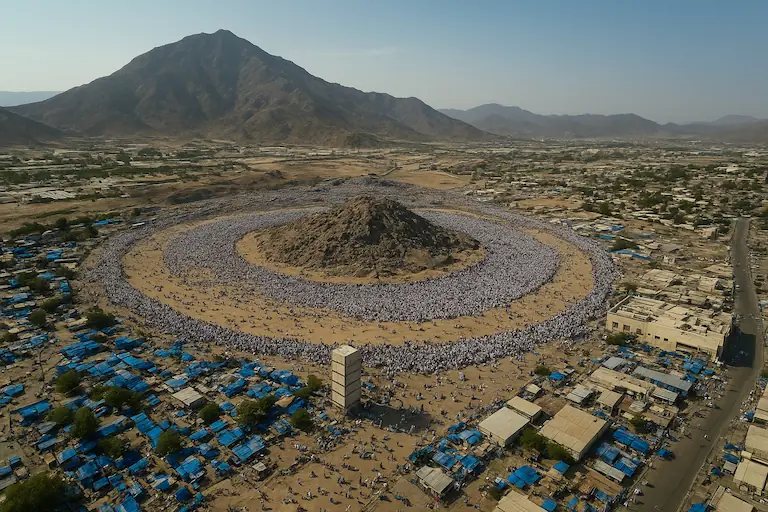

The top 12 must-see places in Makkah are Masjid al-Haram, the Kaaba, the Zamzam Well, Safa and Marwah, Maqam Ibrahim, the Cave of Hira on Jabal al-Nour, Jannat ul-Mu’alla cemetery, the Cave of Thawr on Jabal Thawr, Jabal ar-Rahmah at Arafat, Masjid Nimra, the Abraj Al-Bait Clock Tower Museum, and Masjid Aisha at Taneem. Each site connects directly to the Quran, the Sunnah, or the lives of the Prophets and their companions.
This guide covers the 12 places in Makkah that carry the most spiritual weight and historical depth, so you arrive knowing exactly where to go and why it matters.
1. Masjid al-Haram
Masjid al-Haram is the largest mosque on earth and the first place you step into when you arrive in Makkah. It holds millions of worshippers at peak times, and the scale can feel genuinely overwhelming if you have never been before.
For pilgrims travelling from the UK, knowing your entry gates before arrival saves a lot of confusion. Gate 79 and Gate 96 are the most practical options depending on which hotel you are staying in along the Ajyad or Ibrahim Al Khalil corridor.
Practical tip: The ground level closest to the Kaaba fills quickly after Fajr and Maghrib. A late morning Tawaf between 10am and noon tends to be calmer and more manageable.
2. The Kaaba
The Kaaba is the cubic structure at the centre of Masjid al-Haram, covered in the black Kiswah cloth with gold Quranic verses stitched across it. It is the Qibla, the point every Muslim on earth faces during Salah.
Performing Tawaf, seven anti-clockwise circuits around the Kaaba, is a core part of Umrah. Many pilgrims say the first sight of it stops them in their tracks. No photograph quite prepares you for it.
What pilgrims often ask us: Can you touch the Kaaba? You can try to reach the Hajar al-Aswad on the eastern corner, but the crowds are very dense most of the time. Pointing toward it at the start of each circuit is valid and widely practised.
3. The Zamzam Well
The Zamzam Well sits around 20 metres east of the Kaaba, inside Masjid al-Haram. It has flowed continuously for thousands of years and is directly tied to the story of Hajar (AS), who searched for water for her son Ismail (AS) between Safa and Marwah.
Zamzam water is available throughout the mosque in cooled dispensers, and sealed bottles are permitted to take home. UK travellers can bring up to five litres per person through customs, though it is worth checking the latest HMRC guidance before you travel as rules can change.
Sunnah note: Drinking Zamzam while standing, facing the Kaaba, and making du’a with intention is a recommended practice. Many scholars point to this specifically as a moment to ask for what you truly need.
4. Safa and Marwah
Sa’i, the walk between Safa and Marwah seven times, is obligatory in Umrah. The route runs through the Mas’aa, a wide air-conditioned corridor inside Masjid al-Haram stretching around 394 metres between the two hills.
You begin at Safa and end at Marwah. Men are encouraged to jog lightly between the green marker lights in the middle section, while women walk the full stretch at a steady pace.
(Worth knowing: the Mas’aa has upper floors designed for wheelchair users and those who find the ground level too crowded. If you or someone travelling with you needs this, the team at Ziyuf Al Rahman can help you plan for it in advance.)
5. Maqam Ibrahim
Maqam Ibrahim is a small gold-encased glass stand located just metres in front of the Kaaba. Inside it is the stone on which Ibrahim (AS) stood while building the upper portions of the Kaaba, with his footprints preserved within it.
Offering two Rak’ahs of prayer behind Maqam Ibrahim after Tawaf is a confirmed Sunnah. The area directly in front of the enclosure gets very congested, so most pilgrims perform these two Rak’ahs a little further back while keeping the Maqam in view.
Common mistake to avoid: Queuing directly in front of the glass for long periods disrupts the Tawaf flow behind you. A respectful look, a quiet moment of reflection, and moving on is the better and more considerate approach during busy times.
6. Cave of Hira on Jabal al-Nour
Jabal al-Nour sits on the northern edge of Makkah. Near its peak is the Cave of Hira, where the Prophet Muhammad (SAW) received the first revelation of the Quran through Angel Jibreel (AS).
The climb takes 30 to 45 minutes depending on your pace. Steps are uneven in places, so wear grip-soled shoes and bring water. Going early in the morning before the heat builds makes the whole experience better.
(A note for UK pilgrims: many assumes this climb is only for the very fit. We have guided pilgrims in their 60s to the top. Take your time, rest at the stone ledges along the route, and you will get there.)
The cave itself is small, fitting only a few people at a time. Give yourself quiet moments inside rather than rushing for a photograph. That stillness at the top is something you will carry home with you.
7. Jannat ul-Mu’alla Cemetery
Jannat ul-Mu’alla is a sacred burial ground a short walk from Masjid al-Haram in the Al-Hujun area. Sayyida Khadijah (RA), the Prophet’s (SAW) first wife, is buried here alongside other members of his family and early companions.
Visiting to make du’a and reflect is something many pilgrims consider the most personal part of their trip. The site has set opening times and separate entry points for men and women. Check the current schedule through Ziyuf Al Rahman before you go, as times shift across different seasons.
Photography inside is discouraged out of respect for those in prayer around you. Keep your visit quiet and intentional.
8. Cave of Thawr on Jabal Thawr
Jabal Thawr stands on the southern side of Makkah. The Cave of Thawr on its peak is where the Prophet (SAW) and Abu Bakr al-Siddiq (RA) sheltered for three days during the Hijrah, the migration to Madinah.
The climb is steeper than Jabal al-Nour and takes around 45 minutes to an hour. It tends to be quieter than Jabal al-Nour, which gives the visit a calmer, more reflective feel.
Plan this as a dedicated morning trip rather than a quick stop between prayers. It is further from the Haram than most pilgrims expect. Ziyuf Al Rahman arranges (optional) guided transport to Jabal Thawr as part of the ziyarah schedule, so you are not left navigating it on your own.
9. Jabal ar-Rahmah at Arafat
Jabal ar-Rahmah, the Mount of Mercy, stands on the plain of Arafat around 20 kilometres from Masjid al-Haram. This is where the Prophet (SAW) delivered his Farewell Sermon and where Adam (AS) and Hawwa (AS) are said to have reunited after their descent to earth.
Standing on the plain of Arafat in du’a from after midday until sunset is the central act of Hajj. Umrah pilgrims visiting outside Hajj season can still travel here to walk the plain and visit the area.
Bring sun protection, comfortable shoes, and plenty of water. The plain is exposed and the heat is real. Every pilgrim we have brought here says the atmosphere on that plain is unlike anything they expected.
10. Masjid Nimra
Masjid Nimra stands at the edge of the Arafat plain, near the spot where the Prophet (SAW) delivered his Farewell Sermon. It is one of the larger mosques in the Makkah region and carries real significance for anyone visiting Arafat.
During Hajj, the Imam leads the combined Dhuhr and Asr prayers here before the wuquf on the plain begins. For Umrah pilgrims, pairing a visit to Masjid Nimra with a trip to Arafat rounds out the experience well.
11. Abraj Al-Bait Clock Tower Museum
The Abraj Al-Bait complex towers directly above Masjid al-Haram and is visible from almost all of central Makkah. Inside is the Makkah Museum, also called the Clock Tower Museum, which holds artefacts and displays covering the history of the Two Holy Mosques and the Kaaba across centuries.
Entry is free and the layout works well for English-speaking visitors. If you have a free afternoon and want context for everything you have already seen during Umrah, this is a good use of your time.
Some pilgrims prefer to spend every spare moment in the Haram, and that is a completely valid choice. Go here if your group has space in the schedule and wants to understand what they have been walking through.
12. Masjid Aisha at Taneem
Masjid Aisha, also called Masjid al-Taneem, sits around 7.5 kilometres from Masjid al-Haram on the road toward Madinah. It marks the Haram boundary and is the closest Miqat point to Makkah.
Pilgrims already in Makkah who want to perform an additional Umrah travel here to enter ihram. The Prophet (SAW) directed Aisha (RA) to this exact spot to enter ihram, and that is how the mosque got its name.
Many UK pilgrims planning a second Umrah during their trip arrange a taxi here independently. Ziyuf Al Rahman includes Masjid Aisha as a scheduled option in longer packages, so you do not have to sort the transport yourself.
How to Actually Plan Your Ziyarah in Makkah
Most UK pilgrims have between 7 and 14 days in the Hijaz. Splitting your time well across Makkah and Madinah is the difference between a rushed visit and one you come home feeling settled about.
Here is a realistic framework that works for most groups travelling from the UK:
- Days 1 to 2: Focus entirely on the Haram. Settle in, perform your Umrah, and spend time in prayer. Do not try to visit any external sites yet.
- Day 3: Walk to Jannat ul-Mu’alla cemetery and spend time in the Abraj Al-Bait museum if your group has the afternoon free.
- Day 4: Visit Jabal al-Nour for the Cave of Hira. Go after Fajr before the heat and the crowds arrive.
- Day 5: Travel to Arafat, walk the plain, and visit Masjid Nimra. Pair this with Jabal ar-Rahmah on the same trip.
- Day 6: Take the trip to Jabal Thawr and the Cave of Thawr. Give it a full morning.
- Day 7 onwards: Return to the Haram for extended worship, perform a second Umrah from Masjid Aisha if you wish, and use any remaining time for personal reflection at the sites that meant the most to you.
This is not a rigid itinerary. It is a starting point. Your physical ability, prayer schedule, and personal priorities all shape how it actually runs.
What Pilgrims From the UK Often Get Wrong
Packing too many sites into one day. Makkah is not a city you rush through. The spiritual value of these places comes from presence, not from ticking them off a list.
Underestimating the heat. Summer temperatures in Makkah regularly exceed 40 degrees Celsius. UK pilgrims especially are not used to that level of heat. Light, loose clothing, good sunscreen, and constant hydration are not optional.
Not checking site access times in advance. Jannat ul-Mu’alla, certain areas of the Haram, and some ziyarah sites have restricted access at specific times. Turning up and finding a site closed is avoidable with a quick check beforehand.
Going without a knowledgeable guide for the mountains. Jabal al-Nour and Jabal Thawr both have paths that split and confuse first-time visitors. Going with someone who knows the route saves time, energy, and occasionally mild panic.
Plan Your Umrah with Ziyuf Al Rahman
At Ziyuf Al Rahman, we work specifically with Muslim families and individuals travelling from the UK. Our Umrah packages include (optional) guided ziyarah trips to all 12 sites in this guide, transport, and on-the-ground support throughout your stay in Makkah.
You do not have to figure out the logistics on your own. We handle the schedule, the transport, and the guidance so you can focus entirely on your ibadah and your connection to these places.
Ready to plan your trip? Contact the Ziyuf Al Rahman Team today to discuss your Umrah package and get a plan built around your dates and your needs.
————————
Related Articles:
- Ihram Guide for UK Muslims
- How Long Does Umrah Take from the UK – Complete Guide
- Umrah Visa 2026 for UK Residents – Fees, Eligibility & Application Process
- Types of Umrah Packages 2026 – Which One Is Right for You
- How to Prevent Heatstroke During Umrah and Hajj
- How to Perform Umrah – Step by Step Guide for UK Muslims
- Smart Preparation Guide for Ramadan Umrah 2027 UK
- How Crowded is Makkah for Umrah in December
- Roza e Rasool Visiting Time – Latest Rules for Men & Women
- The Main Gates of Masjid Al Haram
- Complete List of Ziyarat Places in Madinah
- Best Hotels Near Masjid Al Haram Makkah
- Top 10 Umrah Mubarak Gift Ideas to Welcome Loved Ones Home
- Best Month to Go for Umrah 2026 from the UK
- What Is Umrah – Meaning, Rituals & Rules
- How to book a Rawdah appointment