
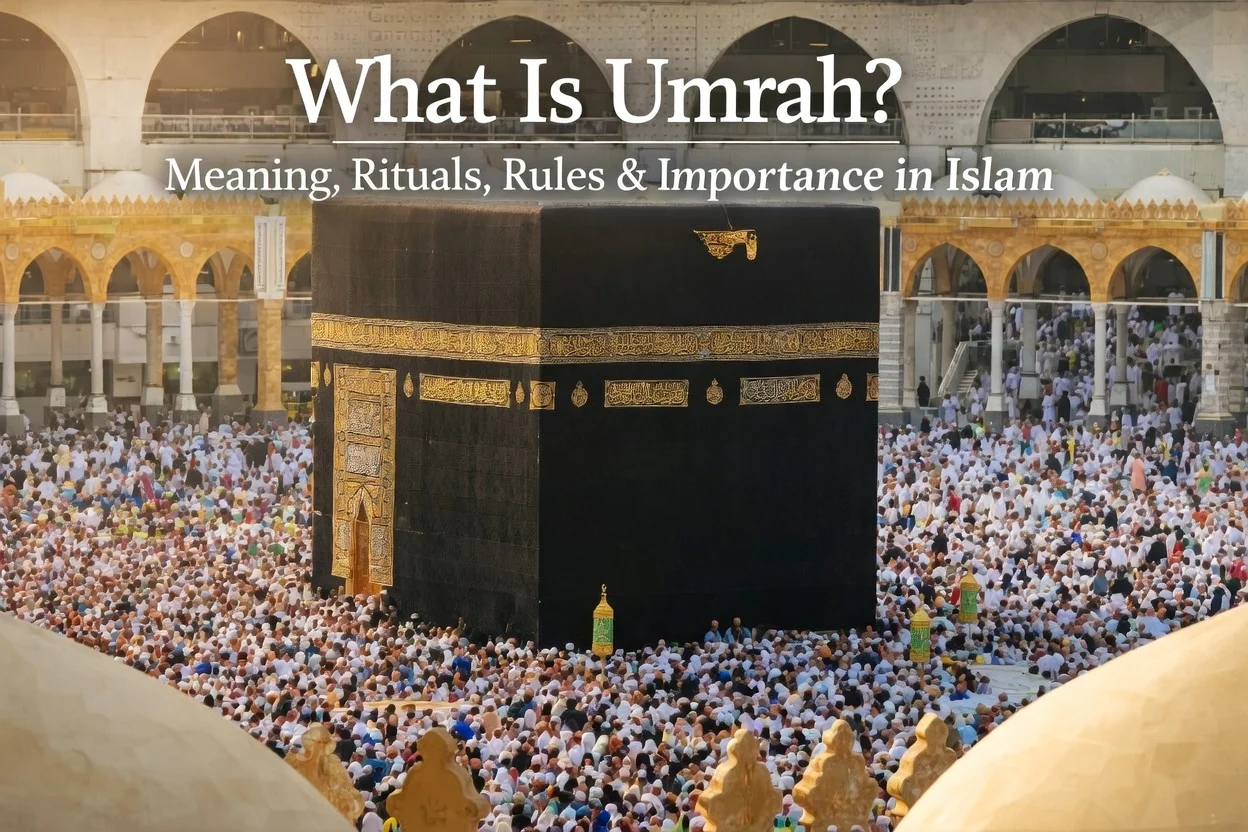

Umrah is the voluntary Islamic pilgrimage to Makkah that Muslims can perform at any time of year. It involves four acts: entering Ihram, circling the Kaaba in Tawaf, walking Sa’i between Safa and Marwa, and shaving or trimming the hair. Not obligatory like Hajj, but the Prophet Muhammad (peace be upon him) described its reward as immense, and performing it in Ramadan is reported to carry a reward comparable to Hajj, as narrated in Sahih Bukhari and Sahih Muslim.
What the Word Umrah Actually Means
Umrah (عُمْرَة) comes from the Arabic root meaning “to visit a populated place.” In Islamic practice, it refers to the pilgrimage to Masjid al-Haram in Makkah, performed outside the fixed Hajj season.
Some call it the “lesser pilgrimage,” but that label only refers to its shorter length. The spiritual weight is entirely its own. You are still standing at the most sacred site on earth, dressed plainly, asking only of Allah.
What the Quran Says
Allah commands the completion of both Hajj and Umrah directly in the Quran.
وَأَتِمُّوا الْحَجَّ وَالْعُمْرَةَ لِلَّهِ
Wa atimmul-Hajja wal-‘Umrata lillah
“And complete the Hajj and Umrah for Allah…”
(Surah Al-Baqarah, 2:196)
The command to “complete” is directed at every Muslim who sets out for either act of worship. Sincerity and proper fulfilment are both built into that single word.
The Quran also names the Sa’i walk between Safa and Marwa as part of the rites:
إِنَّ الصَّفَا وَالْمَرْوَةَ مِن شَعَائِرِ اللَّهِ
Innas-Safaa wal-Marwata min sha’aa’irillah
“Indeed, as-Safa and al-Marwah are among the symbols of Allah. So whoever makes Hajj to the House or performs Umrah, there is no blame upon him for walking between them…”
(Surah Al-Baqarah, 2:158)
Walking between Safa and Marwa is not optional. It is a named rite, rooted in the story of Hajar (may Allah be pleased with her) and her search for water for her son Ismail. Every step you take there connects you to that history.
Why Umrah Matters
The Prophet (peace be upon him) said: “From one Umrah to another is expiation for what is between them,” reported in Sahih Bukhari and Sahih Muslim. That is the clearest summary of what Umrah offers, a genuine wiping away of minor sins between each visit.
For UK Muslims, daily life pulls hard in every direction. Work, commutes, school runs, the noise of the news. Umrah cuts through all of it. You travel, you dress simply, and you stand as one among millions of believers with no rank between you.
People who have been describe coming home feeling lighter. Not because the problems disappeared, but because their perspective on those problems shifted completely. That shift is real, and it tends to last.
Umrah vs Hajj
| Feature | Umrah |
| Obligation level | Sunnah (strongly recommended) |
| When to perform | Any time of year |
| Time to complete | A few hours |
| Includes Arafat | No |
| Ramadan reward | Equal to Hajj (per hadith) |
Hajj, by contrast, is obligatory once in a lifetime for every able Muslim and is tied to specific days in Dhul Hijjah. Umrah has no fixed season and no quota system in the same way, which makes it far more accessible for UK Muslims planning around work and family.
Who Can Perform Umrah
Umrah is open to every Muslim who is physically and financially able. There is no minimum age. Children may perform it with the intention set by their guardian.
General conditions accepted across common practice:
- You must be Muslim and in a state of ritual purity before Ihram
- Your intention must be solely for the sake of Allah
- Women travelling from the UK typically travel with a mahram (a close male relative), though individual circumstances vary and should be checked with a trusted scholar
Understanding the meaning behind each ritual changes how you experience them. Going through the steps without knowing what they represent is like visiting a city without a map. You are there, but you miss most of it.
At Ziyuf Al Rahman, we help UK Muslims prepare properly, practically and spiritually, so your journey carries the weight it deserves.
The Four Rituals of Umrah
Every valid Umrah consists of four acts, performed in order. Missing or skipping any one of them affects the validity of the pilgrimage, so understanding each one before you travel matters.
The four are:
- Ihram: The sacred state of intention and dress entered before arriving at the Miqat (the designated boundary point)
- Tawaf: Seven circuits around the Kaaba, performed counter-clockwise
- Sa’i: Seven lengths walked between the hills of Safa and Marwa
- Halq or Taqsir: Shaving the head completely (Halq) or trimming the hair (Taqsir) to exit Ihram
Each ritual has its own conditions, its own duas, and its own significance. Moving along, here is what each one actually involves.
Step-by-Step: How to Perform Umrah
Step 1: Enter Ihram at the Miqat
Before crossing the Miqat boundary, you must be in a state of ritual purity (Wudu or Ghusl), wear the Ihram garments, and make your intention (Niyyah) to perform Umrah.
For men, Ihram clothing is two plain white unstitched sheets. One wraps around the waist, one over the shoulder. No underwear, no sewn clothing, no covered head.
For women, Ihram is their normal modest clothing covering the whole body. The face and hands remain uncovered during Ihram.
After wearing Ihram, you recite the Talbiyah. This is one of the most recognised duas in all of Islamic ibadah:
لَبَّيْكَ اللَّهُمَّ لَبَّيْكَ، لَبَّيْكَ لَا شَرِيكَ لَكَ لَبَّيْكَ، إِنَّ الْحَمْدَ وَالنِّعْمَةَ لَكَ وَالْمُلْكَ، لَا شَرِيكَ لَكَ
Labbayk Allahumma labbayk, labbayka laa shareeka laka labbayk, innal-hamda wan-ni’mata laka wal-mulk, laa shareeka lak
“Here I am, O Allah, here I am. Here I am, you have no partner, here I am. Verily all praise, grace and sovereignty belong to You. You have no partner.”
You continue repeating the Talbiyah until you begin Tawaf.
Step 2: Perform Tawaf
On arrival at Masjid al-Haram, you proceed to the Kaaba and perform seven circuits, starting and ending at the Black Stone (Al-Hajar al-Aswad).
Each circuit begins with facing the Black Stone. If you can reach it, you touch or kiss it. Most pilgrims simply raise their right hand toward it and say: Bismillah, Allahu Akbar.
You walk counter-clockwise, keeping the Kaaba to your left throughout. Men are encouraged to walk briskly for the first three circuits (a practice called Ramal), then walk normally for the remaining four.
No specific duas are obligatory during Tawaf. You may recite whatever you know, make personal dua, or simply keep your heart present and attentive.
Step 3: Walk Sa’i Between Safa and Marwa
After Tawaf, you perform two rak’ahs of prayer (ideally near Maqam Ibrahim), then proceed to the hills of Safa and Marwa.
Sa’i is seven lengths, not seven return trips. Safa to Marwa is one length, Marwa back to Safa is another. You begin at Safa and end at Marwa.
When you reach Safa for the first time, face the Kaaba and recite:
Innas-Safaa wal-Marwata min sha’aa’irillah
(Surah Al-Baqarah, 2:158, as cited above)
Men jog lightly between the green markers inside the Sa’i corridor. Women walk the full distance at a regular pace.
Step 4: Halq or Taqsir (Hair Cutting)
This is the final ritual and the act that formally exits you from Ihram.
Men shave their heads completely (Halq) or trim at least a thumb-length from all around the hair (Taqsir). Shaving is considered the stronger act. Women trim a fingertip-length from the ends of their hair only.
After this, Ihram restrictions are lifted and your Umrah is complete.
Ihram Rules: What You Must Avoid
Entering Ihram is not just about clothing. It is a state of restriction and heightened awareness. These prohibitions apply from the moment you make your intention at the Miqat until you exit Ihram with Halq or Taqsir.
Prohibited for both men and women during Ihram:
- Cutting hair or nails
- Using perfume or scented products
- Physical relations or anything leading toward them
- Hunting or harming animals
- Arguing, using bad language, or behaving impatiently
- Covering the face (for women) or the head (for men)
Additionally prohibited for men:
- Wearing stitched or sewn clothing
- Wearing socks or covered shoes (the top of the foot must remain visible)
- But here is the catch: many first-time pilgrims from the UK unknowingly breach Ihram by using hotel toiletries, spraying deodorant, or wearing socks out of habit. Pack unscented products before you fly and keep a separate Ihram bag ready and labelled. You can read more about ihram in details in this article: Ihram Guide for UK Muslims
Common Mistakes UK Muslims Make
Knowing what goes wrong helps you avoid it. These are the most frequent issues we see:
- Entering Ihram after crossing the Miqat boundary (the intention must come before, not after)
- Losing count during Tawaf circuits (use a counter or track carefully, do not guess)
- Starting Sa’i at Marwa instead of Safa
- Rushing through the rituals without any dua or presence of mind
- Not trimming enough hair to properly exit Ihram
None of these mistakes are permanent. Most have a remedy (fidyah or a corrective act), but avoiding them entirely means your Umrah runs cleanly and with full peace of mind.
Ziyuf Al Rahman guides UK pilgrims through every one of these points during pre-departure preparation, so you are not working it out for the first time while you are standing in Makkah.
Planning Umrah from the UK
UK Muslims travel for Umrah year-round, from London, Birmingham, Manchester, Bradford, and beyond. Flights connect directly to Jeddah and Madinah, and packages range from budget to premium depending on hotel proximity to the Haram and the time of year.
Knowing when to go changes the whole experience.
Best Time to Go
| Period | What to Expect |
| Ramadan | Highest reward, most crowded, higher costs |
| Rajab and Sha’ban | Quieter, moderate prices, good for first-timers |
| Muharram | Least crowded, lower prices, cooler weather |
| UK school holidays | Busy with families, book early |
Ramadan Umrah carries the greatest spiritual reward, but the crowds around the Kaaba are intense. Many people who have been more than once will tell you quietly: go in a quieter month first. Learn the rituals in peace, then return in Ramadan when you know exactly what you are doing.
What to Pack for Umrah
You really do not need much. That is part of the point.
- Two sets of Ihram garments (men) or comfortable, full-coverage clothing (women)
- Unscented soap, shampoo, and deodorant (scented products are prohibited in Ihram)
- Comfortable walking sandals (you will walk several kilometres each day)
- A small Quran or Quran app on your phone
- A printed dua card for Tawaf and Sa’i (easier than scrolling in a crowd)
- All travel documents including your Umrah visa printout
- A full supply of any regular medication
One thing many UK pilgrims miss: check every product in your toiletry bag before you fly. Hotel toiletries in Makkah are often scented. Bring your own unscented alternatives and keep them in a separate bag labelled clearly.
Prepare Spiritually, Not Just Logistically
Most people spend more time choosing a hotel than learning the duas. That is understandable, but it costs you something on the ground.
Read about Ibrahim and Ismail (peace be upon them) before you go. Understand why Hajar ran between Safa and Marwa. When you walk that same path yourself, it will not feel like a ritual you are completing. It will feel like a story you are stepping into.
At Ziyuf Al Rahman, we run pre-departure sessions for UK Muslims covering every ritual, common questions, and what to expect when you arrive. You show up informed, not figuring things out on the spot.
Ready to Go? Let Ziyuf Al Rahman Help
Sorting flights, visas, hotels, and pre-departure preparation on your own takes real effort. And when something is not right, you only find out once you are already there.
Ziyuf Al Rahman has worked with UK Muslims across England for years, handling the practical side so you can focus on why you went in the first place. From Umrah package selection to pre-travel prep and on-ground support, we are with you through it.
Visit ziyufalrahman.co.uk to explore packages or Speak to the team directly.
———————
Related Articles:
- Guide to the Main Gates of Masjid Al-Haram
- Best Times to Make Dua During Hajj and Umrah
- Roza-e-Rasool Visiting Times and Rules
- How Much Does an Umrah Package Cost from the UK?
- How to Book Umrah from London with a low Deposit
- How Many Umrahs Can Be Performed in One Day
- Top 10 Umrah Mubarak Gift Ideas
- Step-by-Step Umrah Guide for UK Pilgrims
- 2026 Umrah Visa Guide for UK Residents
- Best Month to Perform Umrah in 2026 from the UK
- How Crowded is Makkah for Umrah in December
- The Spiritual Significance of Umrah in Islam
- Smart Preparation Guide for Ramadan Umrah 2027 UK
- Umrah Meaning, Rituals, and Rules Explained
- Key Facts About Fasting During Umrah
- Performing Umrah After Ramadan and Before Hajj
- Final Umrah Closing Dates Before Hajj
- Best Hotels Near Masjid Nabawi in 2026
- Can You Perform Umrah for the Deceased?
- Complete List of Ziyarat Places in Madinah
- Miqat points for Umrah from the UK
- Most common questions asked while booking Umrah packages