
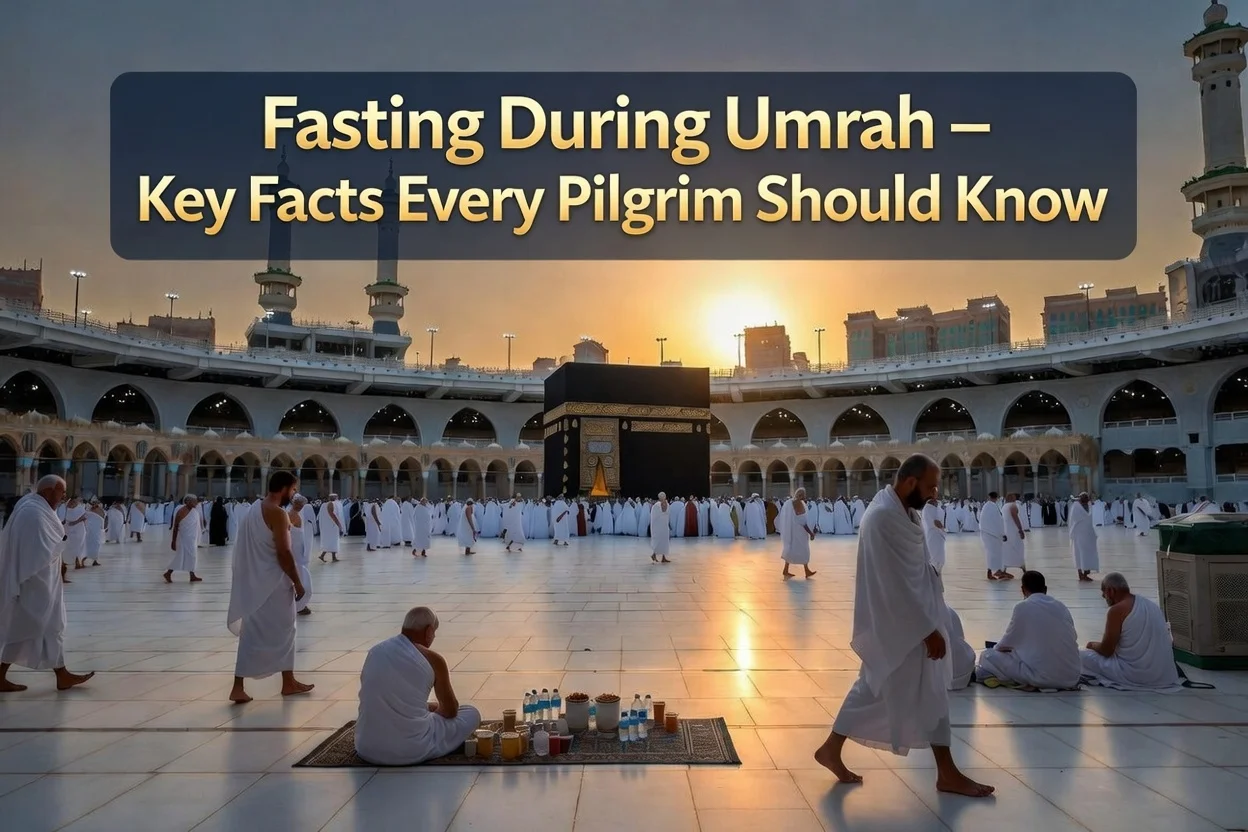

Fasting during Umrah is not compulsory. As a travelling pilgrim, Islam gives you a valid concession to skip your fast. You can fast if you feel strong and healthy. If the heat and rituals make it genuinely difficult, you make up those days after Ramadan ends.
Many UK Muslims arrive in Makkah carrying a quiet worry: “If I skip my fast during Umrah, have I sinned?” That fear is understandable. But it comes from a misunderstanding we see often, and it is one worth clearing up before you step into ihram.
Is Fasting Compulsory During Umrah?
No, it is not. Fasting in Ramadan is a pillar of Islam, but travelling changes the ruling. Once you leave the UK for Umrah, you become a musafir (a traveller), and a specific Islamic allowance kicks in.
Your Umrah stays completely valid whether you fast or not. Your intention and how correctly you perform each ritual matter far more than whether you kept your fast that day.
The Concession Islam Gives Travellers
We call this a rukhsah. It means a permitted concession, and Allah placed it in the religion as an act of mercy, not as a loophole.
Allah says in the Quran:
فَمَن كَانَ مِنكُم مَّرِيضًا أَوْ عَلَىٰ سَفَرٍ فَعِدَّةٌ مِّنْ أَيَّامٍ أُخَرَ
Faman kaana minkum mareedhan aw ‘alaa safarin fa’iddatun min ayyaamin ukhar
“And whoever among you is ill or on a journey, then an equal number of other days.”
Surah Al-Baqarah, 2:184
This verse is your direct Quranic permission. Skipping your fast on the road is not bending the rules. It is following them exactly as Allah intended.
A narration reported by Ibn Majah states that Allah loves for His concessions to be accepted, much as He loves His firm rulings to be followed. Taking the rukhsah is obedience, not weakness.
Why This Matters Specifically for UK Pilgrims
Flying from the UK to Makkah alone qualifies you as a musafir under widely accepted Islamic practice. But add the full reality of Umrah on top of that journey, and the concession becomes even more relevant:
- Tawaf covers roughly 3.5 km of walking around the Kaaba (seven full circuits)
- Sa’i adds another 2.8 km between Safa and Marwa
- Makkah heat regularly pushes past 35 degrees Celsius, even outside peak summer
- Most UK pilgrims are simply not used to that level of heat and exertion combined
Islam does not ask you to harm yourself in worship. You are there to connect with Allah, not to prove endurance.
The ruling is straightforward: fast if you are healthy and feel capable, use the concession if the journey creates real difficulty, and know your Umrah is valid either way.
The Purpose Behind Ramadan Fasting
But here is the thing. Understanding what fasting is actually for helps you see why this concession makes complete sense. Allah says:
يَـٰٓأَيُّهَا ٱلَّذِينَ ءَامَنُوا۟ كُتِبَ عَلَيْكُمُ ٱلصِّيَامُ كَمَا كُتِبَ عَلَى ٱلَّذِينَ مِن قَبْلِكُمْ لَعَلَّكُمْ تَتَّقُونَ
Yaa ayyuha alladheena aamanoo kutiba ‘alaykumu as-siyaamu kamaa kutiba ‘alaa alladheena min qablikum la’allakum tattaqoon
“O you who have believed, decreed upon you is fasting as it was decreed upon those before you, so that you may attain taqwa.”
Surah Al-Baqarah, 2:183
Fasting exists to build taqwa, meaning closeness to Allah and inner God-consciousness. Performing Umrah builds that same closeness through a different door.
We have seen pilgrims feel guilty for using this concession (even when they are visibly exhausted after Tawaf in July heat). The guilt is misplaced. Allah opened that door for you. Walking through it is an act of gratitude, not compromise.
The Reward of Performing Umrah in Ramadan
Moving along, here is something that changes how many pilgrims feel about the whole question. Combining Umrah with Ramadan carries an extraordinary spiritual reward, whether you fast the entire time or not.
The Prophet Muhammad (peace be upon him) said: “Umrah in Ramadan is equivalent to performing Hajj with me.” Reported in Sahih Bukhari and Sahih Muslim.
That reward is attached to the act of going, not to whether you skipped your fast on a particular day. We share this with every pilgrim we speak to because it reframes the entire journey. You are not choosing between Ramadan and Umrah. You are getting both, at a level of reward most Muslims only dream of.
Fasting in Ramadan vs. Outside Ramadan
The ruling shifts slightly depending on when you travel, so it helps to see it broken down cleanly.
If you travel for Umrah during Ramadan:
- Fasting is optional for travellers due to the rukhsah
- Any missed days must be made up after Ramadan ends
- Your Umrah is fully valid regardless of whether you fasted
If you travel for Umrah outside Ramadan:
- There is no obligatory fast to keep or skip
- Voluntary (nafl) fasting is permitted and welcomed anytime
- Many pilgrims choose to fast on Mondays, Thursdays, or the white days (13th, 14th, 15th of the Islamic month) during their trip
When to Skip Your Fast: A Practical Guide
This is where people get genuinely confused. The concession exists, but knowing when to actually use it makes a real difference on the ground.
Skip your fast if:
- You feel dizzy, weak, or nauseous during Tawaf or Sa’i
- You are performing Umrah in summer when Makkah temperatures exceed 40 degrees Celsius
- You have a health condition such as diabetes, heart issues, or low blood pressure
- A doctor or trusted scholar has advised against fasting while travelling
- The fast is genuinely putting the quality of your worship at risk
You may choose to fast if:
- You are in good health and have some experience of Umrah before
- You are travelling in cooler months (November to February offer far more manageable conditions)
- You plan your rituals around Suhoor and Iftar times to protect your energy
The key word across all of this is honesty. Go with a truthful assessment of your own body and capacity.
Timing Your Rituals Around Fasting
On top of that, practical timing makes a huge difference for pilgrims who do choose to fast. Many who combine Ramadan fasting with Umrah successfully do so by planning around the cooler parts of the day:
- After Tarawih prayers (late night, post-Iftar): cooler temperatures and far fewer crowds around the Kaaba
- Before Fajr (last part of the night): some pilgrims complete Tawaf close to Suhoor time when the Masjid is at its quietest
- Avoid midday and early afternoon: heat peaks during these hours and fasting pilgrims are most at risk
We always pass this advice on to our pilgrims at Ziyuf Al Rahman, especially first-timers travelling in Ramadan. Timing your worship well is not cutting corners. It is protecting your ibadah.
A Real Scenario Worth Picturing
Consider a family from Manchester travelling for Umrah in Ramadan. The husband is fit and experienced. His wife has mild anaemia. Their elderly mother is joining for the first time.
- The husband fasts and performs Tawaf after Tarawih each night with full energy
- His wife uses the rukhsah, skips her fast daily, and makes up six days after Eid
- The grandmother also uses the concession and completes her Umrah safely and spiritually whole
Three people, three different choices, and all three are correct. That flexibility is not a weakness in Islamic practice. It reflects how deeply Allah understands the reality of human beings.
A Short Dua for Strength During Your Journey
If you are fasting and finding the rituals physically demanding, this widely known dua for ease is worth reciting often:
اللَّهُمَّ لَا سَهْلَ إِلَّا مَا جَعَلْتَهُ سَهْلًا، وَأَنْتَ تَجْعَلُ الْحَزْنَ إِذَا شِئْتَ سَهْلًا
Allahumma laa sahla illaa maa ja’altahu sahlan, wa anta taj’alul hazna idhaa shi’ta sahla
“O Allah, nothing is easy except what You make easy, and You can make difficulty easy when You will.”
Recite it during Tawaf, between circuits of Sa’i, or whenever fatigue sets in. Asking Allah for ease is entirely within the spirit of this journey.
Mistakes Pilgrims Make Around Fasting and Umrah
We have seen the same errors come up again and again, particularly from first-time travellers from the UK. Knowing these in advance saves a lot of unnecessary stress.
Feeling guilty for using the concession:
Many pilgrims skip their fast out of necessity and then spend the rest of the day feeling like they did something wrong. The guilt itself becomes a distraction from ibadah. The rukhsah is not a shortcut. It is a gift from Allah, and using it is an act of obedience.
Pushing through exhaustion and ruining the experience:
Some pilgrims force themselves to fast through every ritual regardless of how they feel, then become too unwell to complete Sa’i or spend time in dua and dhikr. Your goal is quality worship, not endurance. Completing Umrah with a present heart matters more than completing it while fasting.
Not making up missed days properly:
If you skip your fast during Umrah in Ramadan, those days must be made up before the next Ramadan arrives. Many pilgrims forget this or delay it without a plan. Make a note of exactly how many days you missed before you board your flight home.
Fasting without enough hydration between Iftar and Suhoor:
Pilgrims who do choose to fast sometimes underestimate how much water they lose during Tawaf and Sa’i. Drink consistently between Iftar and Suhoor (and not just at both ends). Your body needs it more during Umrah than a typical day at home in the UK.
Plan Your Umrah With Ziyuf Al Rahman
We get these questions from UK Muslims every single week, and we understand why. Umrah is one of the most significant journeys of your life, and you want to arrive prepared, not anxious.
At Ziyuf Al Rahman, our Umrah packages are built around making your experience as smooth and spiritually focused as possible. From first-time pilgrims in their twenties to elderly travellers making a lifelong dream a reality, we have helped families from across the UK plan trips that genuinely worked for them (and not just on paper).
Whether you are travelling in Ramadan or any other time of year, fasting or using the concession, our team will help you plan every detail so that when you stand in front of the Kaaba, your only focus is on Allah.
Explore our Umrah packages and speak to our team today
————————
Related Articles:
- Best Times to Make Dua During Hajj and Umrah
- Top 12 Must-See Places in Makkah
- Ihram Guide for UK Muslims
- How Many Umrahs Can Be Performed in One Day
- Umrah Visa 2026 for UK Residents – Fees, Eligibility & Application Process
- Smart Preparation Guide for Ramadan Umrah 2027 UK
- What to Do on Laylatul Qadr – A Guide for Umrah Pilgrims
- How to Prevent Heatstroke During Umrah and Hajj
- How to Perform Umrah – Step by Step Guide for UK Muslims
- Roza e Rasool Visiting Time – Latest Rules for Men & Women
- Planning Umrah in the Christmas Holidays
- The Main Gates of Masjid Al Haram
- Difference Between Hajj and Umrah
- How Much Does an Umrah Package Cost from the UK
- Top 10 Umrah Mubarak Gift Ideas to Welcome Loved Ones Home
- Best Month to Go for Umrah 2026 from the UK
- What Is Umrah – Meaning, Rituals & Rules
- Can You Perform Umrah for the Deceased?
- How to book a Rawdah appointment