
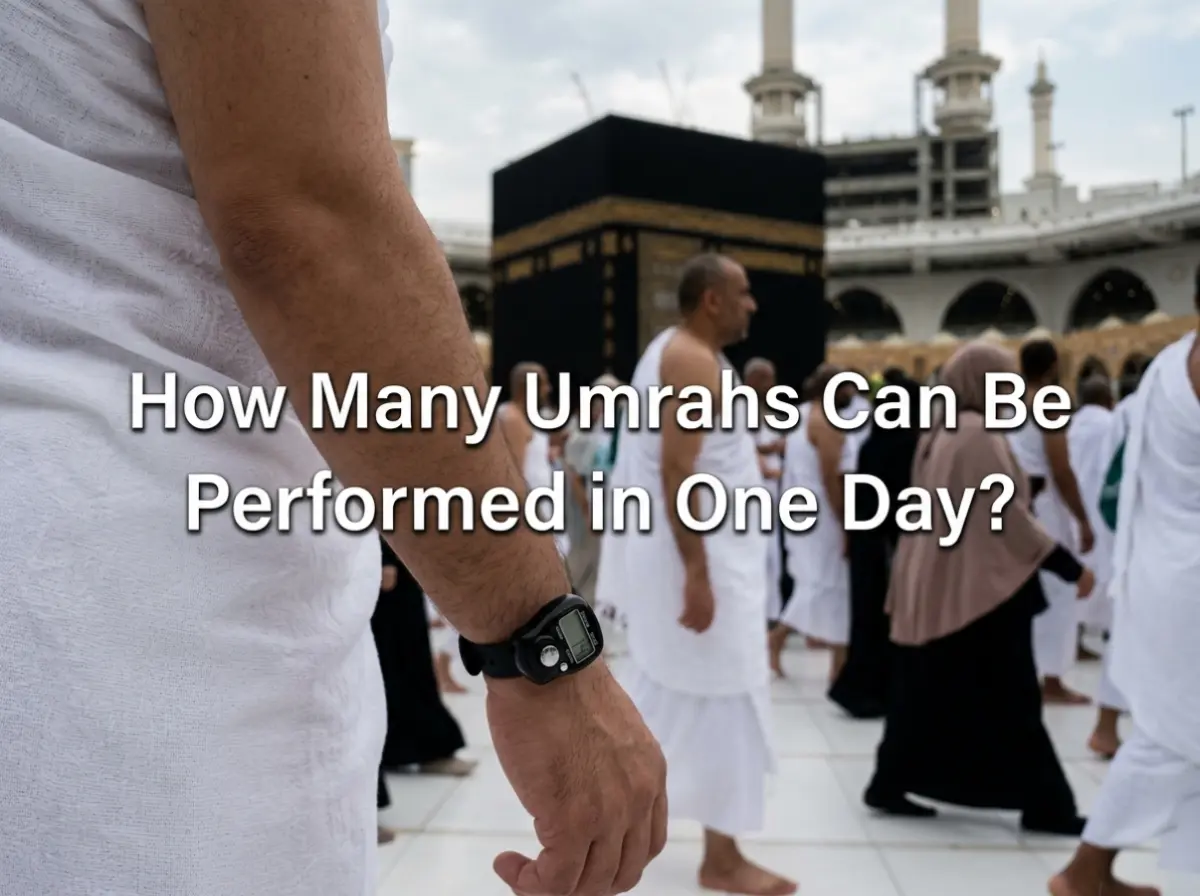

There is no fixed limit in the Sharia texts on how many Umrahs you can perform in a single day. According to the majority of scholars, two or more Umrahs in one day are permissible, provided you fully complete each one and re-enter Ihram from outside the Haram boundary before starting the next. In practice, two Umrahs in a day is what most pilgrims realistically achieve.
(This guide is written for ordinary pilgrims and draws on the mainstream positions of contemporary scholars such as Shaykh Ibn Baz, classical works like those of Ibn al‑Qayyim, and fatwas from recognized fiqh sites such as Islamweb, alongside our on-the-ground experience with UK groups in Makkah. It is not a replacement for asking a trusted local scholar about your specific situation.)
What the Scholars Say
The majority of contemporary scholars, including councils and fatwa bodies in the Muslim world, do not require any fixed waiting period between two Umrahs, as long as each Umrah is completed properly with Ihram, Tawaf, Sa’i, and Halq or Taqsir. Shaykh Abdul Azeez ibn Baaz (may Allah have mercy on him) was asked directly whether it is permissible to perform a second Umrah in the same season, and his response was clear: “There is no harm in that, and all praise is due to Allah.”
He also confirmed: “There is no clear evidence for stipulating a specific duration between two Umrahs. The Prophet’s (peace be upon him) general statement encompasses both short and long intervals.”
The hadith is reported in both Sahih Bukhari and Sahih Muslim:
“Umrah to Umrah is an expiation for what is between them, and an accepted Hajj has no reward but Paradise.”
(Reported in Sahih Bukhari and Sahih Muslim)
Scholars mention this hadith as evidence that repeat Umrahs are a recognised form of worship, and they note that the Prophet (peace be upon him) did not specify any minimum gap between them in this text.
The Example of Aisha (May Allah Be Pleased with Her)
The clearest proof that same-visit Umrah is permissible comes from what the Prophet (peace be upon him) permitted for Aisha (may Allah be pleased with her). During the farewell pilgrimage, she sought permission to perform a separate Umrah. The Prophet (peace be upon him) ordered her brother Abdur-Rahman to take her to Tan’eem, from where she entered Ihram and returned to perform a second Umrah.
Islam web notes it plainly: “Verily he would not have given permission except for something that was permissible in Islam.”
Aisha’s second Umrah happened less than twenty days after her first, with the Prophet’s (peace be upon him) full knowledge and instruction. That is the foundation of the majority position.
A Nuance Worth Knowing
Some earlier scholars, including Ibn al-Qayyim (may Allah have mercy on him), noted that the Prophet (peace be upon him) himself never left Makkah mid-stay to perform a repeat Umrah, and neither did most of his Companions. The practice of exiting to Tan’eem for a second Umrah within the same visit was specific to Aisha, due to her particular circumstances.
This does not make it prohibited. What it means is that spending extra time inside the Haram, doing Tawaf, making dua, and sitting in prayer, also carries enormous reward and is closer to what the Prophet (peace be upon him) modelled. Both paths are valid. Neither replaces the other.
The key condition: You cannot begin a new Umrah from inside the Haram. You must physically exit the boundary of the Haram, re-enter a state of Ihram from an area known as the Hill (the zone outside the sanctuary), and then return. The most commonly used exit point for pilgrims is Masjid Aisha at Tan’eem, which is approximately 7.5 kilometres from Masjid al-Haram. Without this step, your second Umrah is not valid.
How to Actually Do a Second Umrah the Same Day
You know the ruling. Now here is what you actually do when you are standing in Makkah, your first Umrah complete, and you want to perform another one before the day is out. We have broken this down the way we would explain it to a fellow pilgrim in the courtyard.
Finish the First Umrah Completely
Your first Umrah has to be properly closed before anything else begins. That means four steps, all of them done.
- Ihram: Enter from your Miqat, make your Niyyah, and begin the Talbiyah.
- Tawaf: Seven circuits of the Kaaba, anti-clockwise, starting at the Hajar al-Aswad, followed by two rak’ahs near Maqam Ibrahim.
- Sa’i: Seven laps between Safa and Marwah, starting at Safa and ending at Marwah.
- Halq or Taqsir: Shave or trim your hair to exit Ihram and close the Umrah.
That final step is where most people slip up. You are not out of Ihram until the hair is cut. We cannot stress this enough. Skipping or delaying Halq or Taqsir out of tiredness (and you will be tired) means you are technically still inside the first Umrah and cannot begin the second.
Head to Masjid Aisha at Tan’eem
Moving along, once your first Umrah is fully wrapped up and you have exited Ihram, you need to travel outside the Haram boundary. The closest and most used point is Masjid Aisha, also known as Masjid Tan’eem, sitting around 7.5 kilometres from Masjid al-Haram.
Taxis run from outside the Haram gates around the clock. The ride takes 10 to 20 minutes depending on how busy the roads are. Your hotel in central Makkah sits inside the Haram boundary, so you cannot simply re-enter Ihram in your room and walk back. The trip to Tan’eem is not optional.
Enter Ihram and Head Back
At Masjid Aisha, perform ghusl if you can manage it, or wudhu at minimum. Change into your Ihram garments, pray two rak’ahs, and make your Niyyah for the second Umrah.
Then recite the Talbiyah:
Labbayka Allahumma labbayk. Labbayka la shareeka laka labbayk. Inna al-hamda wa al-ni’mata laka wa al-mulk. La shareeka lak.
“Here I am, O Allah, here I am. Here I am, You have no partner, here I am. Truly all praise, grace and sovereignty belong to You. You have no partner.”
Keep reciting on the journey back until you are at the Haram and about to begin Tawaf. Then perform the second Umrah in full, just as you did the first. Tawaf, two rak’ahs, Sa’i, then Halq or Taqsir. No shortcuts.
The Mistakes We See UK Pilgrims Make
What follows is based on what we have personally seen with UK groups on the ground; it is experience-based, not a formal fatwa. These are not theoretical. We see these happen on real trips, and knowing them before you land saves you a lot of stress.
Skipping Halq or Taqsir after the first Umrah. This is the most common error by far. No hair cut means no valid exit from the first Ihram, and that means no valid second Umrah.
Re-entering Ihram from the hotel. Your central Makkah hotel sits inside the Haram boundary. That makes it an invalid Miqat point for a repeat Umrah. The trip to Masjid Aisha is required, not optional.
But here is the catch most people do not see coming. Underestimating how physically demanding this is. Each Umrah means several kilometres of walking inside the Haram, plus the return trip to Tan’eem. If you are travelling from the UK in summer months, Makkah temperatures can easily sit above 40 degrees Celsius. Two full Umrahs in that heat is genuinely tough, and three requires real stamina and a very early start.
Performing Umrah for a deceased family member before your own. Complete your own Umrah first. Then you may offer a subsequent one on behalf of a loved one.
How Many Is Realistic?
Two in a day is very achievable for a healthy adult who plans the day well. Three is possible (and we have seen it done) but it demands an early start and good physical condition. On top of that, a single Umrah performed with full focus and sincerity will always outweigh three rushed ones. The number you complete is not what you will carry home with you. The feeling of standing before the Kaaba, present and unhurried, is what stays.
The Spiritual Side Nobody Talks About
Here is something worth sitting with before you book that taxi to Tan’eem.
The Prophet (peace be upon him), performed only four Umrahs across his entire life. None of them involved leaving Makkah mid-stay to immediately return for another. Scholars like Ibn al-Qayyim (may Allah have mercy on him) noted that the Companions who were with the Prophet (peace be upon him) in Makkah did not make a habit of going out to Tan’eem for repeat Umrahs either.
What they did instead was stay inside the Haram and do Tawaf. And Tawaf, in Makkah, carries its own enormous reward.
Islam web’s fatwa puts it clearly: performing additional Tawaf while already in Makkah may be preferable to leaving and returning specifically for a repeat Umrah, because Tawaf is an act of worship unique to the sacred mosque and cannot be performed anywhere else.
In simple terms: if you are already in Makkah and standing in front of the Kaaba, some scholars say it is often better to stay put and make the most of that unique ibadah (Tawaf, dua, Quran), instead of spending a large chunk of your limited time travelling back and forth to Tan’eem. Others say that for a pilgrim who has travelled far and may never return, going out for another Umrah can also be strongly recommended.
Planning Your Umrah Trip from the UK
For Muslims travelling from cities like London, Manchester, Birmingham, or Bradford, an Umrah trip is often a once-in-several-years journey. You want it to be spiritually rich, logistically smooth, and free of avoidable stress.
A few things that genuinely make a difference for UK pilgrims:
- Book with an ATOL-protected operator. Your flights and accommodation are financially protected if anything goes wrong before or during travel.
- Stay close to the Haram. If you plan to perform multiple Umrahs, proximity matters. A hotel within walking distance of Masjid al-Haram saves you time and energy between each Umrah, and means less taxi cost and less fatigue.
- Travel in cooler months. November through February offers far more manageable temperatures for UK pilgrims not accustomed to Makkah’s heat. Performing multiple Umrahs in 42-degree heat in July is a very different experience from doing so in a cool January.
- Carry your Nusuk permit and Umrah visa details at all times. Saudi authorities carry out checks inside and around the Haram, and having your documents easily accessible avoids unnecessary delays.
- Plan your Tan’eem trip before you need it. Know the taxi rank, know the approximate fare (typically 35 to 50 Saudi Riyals each way), and know how long the journey takes at different times of day. Doing this research on arrival rather than mid-worship saves a lot of stress.
At Ziyuf Al Rahman, we help UK Muslims plan Umrah trips that are practical and spiritually intentional. Whether it is your first trip or you have been before, we can help you build a schedule that gives you real time at the Haram, not just a flight and a hotel room.
Ready to Plan Your Umrah?
If you are a Muslim in the UK thinking seriously about Umrah, whether for yourself, for your family, or to perform one on behalf of a loved one who has passed, Ziyuf Al Rahman is here to help you do it right.
We take care of the logistics so you can focus entirely on your ibadah. Accommodation close to the Haram, ATOL-protected travel, and guidance tailored to UK pilgrims who want to make every moment of their trip count.
Reach out to us today and let us help you plan an Umrah that you will carry with you long after you return home.
Note: This article is a general guide based on widely held scholarly views and our experience with UK pilgrims. It is not a formal fatwa. If you have a complicated situation or follow a specific school of thought, please speak directly with a qualified scholar you trust before acting.
————————
Related Articles:
- Best Times to Make Dua During Hajj and Umrah
- Important Dates in the Islamic Calendar
- Top 12 Must-See Places in Makkah
- What Is Included in All Inclusive Umrah Packages UK
- How Much Luggage Can I Take for Umrah Flights from the UK
- How to Book Umrah from London with a low Deposit
- Ihram Guide for UK Muslims
- Complete List of Ziyarat Places in Madinah
- How Long Does Umrah Take from the UK – Complete Guide
- Planning Umrah in the Christmas Holidays
- Umrah Visa 2026 for UK Residents – Fees, Eligibility & Application Process
- The Spiritual Significance of the Umrah Pilgrimage in Islam
- Smart Preparation Guide for Ramadan Umrah 2027 UK
- What to Do on Laylatul Qadr – A Guide for Umrah Pilgrims
- Fasting During Umrah – Key Facts
- How Crowded is Makkah for Umrah in December
- Best Hotels Near Masjid Nabawi in 2026
- Types of Umrah Packages – Which One Is Right for You
- How to Prevent Heatstroke During Umrah and Hajj
- How to Perform Umrah – Step by Step Guide for UK Muslims
- Roza e Rasool Visiting Time – Latest Rules for Men & Women
- How Much Does an Umrah Package Cost from the UK
- Top 10 Umrah Mubarak Gift Ideas to Welcome Loved Ones Home
- Best Month to Go for Umrah 2026 from the UK
- What Is Umrah – Meaning, Rituals & Rules
- Can You Perform Umrah for the Deceased?
- How to book a Rawdah appointment
- Miqat points for Umrah from the UK