
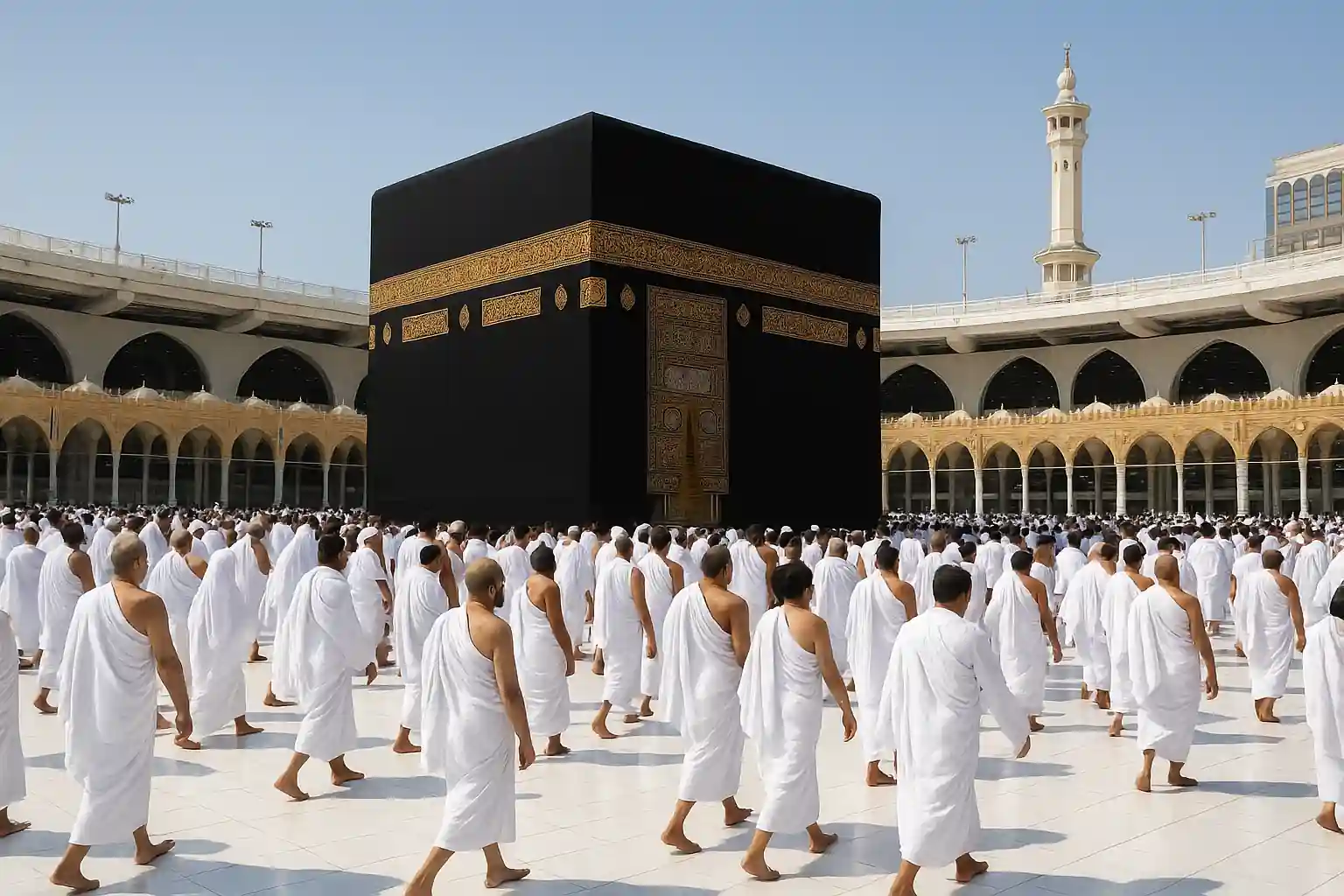

To perform Umrah you: enter Ihram with Niyyah and Talbiyah before crossing the Miqat, perform Tawaf (7 circuits) around the Kaaba, pray two Raka’ah, drink Zamzam, complete Sa’i between Safa and Marwa (7 times), then shave or cut your hair to end Ihram. Each step has a simple intention, basic rules, and recommended duas, and most UK pilgrims complete Umrah in three to five hours once inside Masjid al Haram.
Umrah From the UK in 2026: The Real Pain Point
If you are like most UK pilgrims, you have watched YouTube videos, read a leaflet from a local masjid, and still feel unsure. You worry that you will forget a dua, miss a step, or even break Ihram rules without realising.
We see this every season when nervous first timers sit on our coach in Jeddah still asking, “When exactly do I say the Talbiyah” and “Can I use deodorant now”. So we will walk you through Umrah like you are sitting in that coach with us.
Umrah Steps for UK Muslims
Use this like a mental checklist before we go deeper.
- Make your travel booking with a licensed Umrah operator, and get your Umrah visa and Nusuk arrangements confirmed before you fly.
- Put on Ihram and prepare (Ghusl, nails, clothing) before reaching the Miqat.
- Make Niyyah for Umrah and start the Talbiyah at or just before the Miqat.
- Enter Masjid al Haram, see the Kaaba, then perform Tawaf (7 circuits) and pray two Raka’ah.
- Drink Zamzam, then perform Sa’i between Safa and Marwa (7 trips).
- End by shaving the head (for men) or trimming the hair (for men and women), and exit Ihram.
We will now slow each stage down and add realistic tips for UK travellers.
Before You Fly: UK Readiness for Umrah in 2026
We see two big blockers from UK pilgrims: late paperwork and unclear health rules.
1. Booking, Visa, and Nusuk
From the UK, plan to start booking around 8 to 12 weeks before travel, and earlier if you are going in Ramadan when prices and demand rise sharply. Your passport must have at least six months validity left from your return date and enough blank pages for visas and stamps.
For safety, always check current Foreign, Commonwealth & Development Office (FCDO) guidance on travel to Saudi Arabia, including any changes for pilgrims. This page is updated regularly and is seen as the official UK line for health, security, and entry rules.
2. Vaccinations and Health
The Saudi Ministry of Health requires a valid ACWY meningitis vaccination certificate issued at least 10 days before you arrive for Hajj or Umrah. Many UK GPs and travel clinics provide this and you should book an appointment several weeks before departure to avoid last minute panic.
Carry any regular medication in your hand luggage with a copy of your repeat prescription. Heat, long walks, and crowd pressure are real, so good general fitness and hydration are part of your preparation, not an afterthought.
3. Travel Insurance That Actually Works
We have sadly seen people arrive in Saudi without proper insurance, thinking “I will be fine, it is only a few days”. When someone falls, faints, or needs hospital care, the costs and stress are heavy. Take comprehensive travel insurance that includes medical treatment in Saudi Arabia and emergency repatriation. Many UK Umrah operators bundle this into the Umrah package, but always read the actual policy before you pay and make sure any pre existing condition is declared.
Step 1: Ihram, The Real Start of Your Umrah
On the coach to Makkah or on the plane from the UK, this is the moment people feel the journey shift from “trip” to “ibadah”. (For detailed rulings, refer to a qualified Hanafi scholar or resources such as Darul Iftaa Birmingham or Darul Uloom Bury)
Cleanliness and Ghusl
Before you wear Ihram, sort your personal cleanliness. Clip nails, remove underarm and body hair within halal limits, and take a full Ghusl if you can. If a full bath is hard during travel, Wudu is fine and you can still enter Ihram correctly. Many of pilgrims do Ghusl at home in Stockport or London on the morning of travel, then renew Wudu in the airport.
Ihram Clothing for Men and Women
For men the Ihram is two plain, white, unstitched pieces of cloth: one wrapped around the waist (Izar) and one over the upper body (Rida). Sandals should leave the ankles and most of the top of the foot visible. Learn a simple wrap that you can walk in comfortably, because you will walk a lot.
For women the Ihram is their usual modest Islamic clothing. Any colour is fine as long as it is loose and modest. The face and hands stay uncovered, while socks and normal shoes are allowed. We always remind our sisters: choose something you can pray in comfortably and walk in for several hours.
When and Where to Wear Ihram from the UK
If you fly directly to Jeddah, it is easier to wear Ihram before boarding or on the plane well before the Miqat. The Miqat is the boundary line outside Makkah that you must not cross with Umrah intention unless you are already in Ihram. Airlines usually announce when you are close to the Miqat, but the plane bathrooms become crowded, noisy, and stressful at that moment.
Our practical tip: put on your Ihram at home or at the departure airport, pray two Raka’ah in a quiet corner if the time is suitable, and delay only your actual Niyyah and Talbiyah until you are near the Miqat (we will cover Niyyah and Talbiyah in the next section). If your route is UK to Madinah first, you wear normal clothes in Madinah and enter Ihram later at Masjid Dhul Hulayfah (known locally as Abyar Ali), which is the Miqat for people leaving Madinah for Makkah.
Two Raka’ah Before Ihram
It is Sunnah to pray two Raka’ah before entering Ihram. You can pray this at home, at the airport prayer room, or in your hotel in Madinah. Keep it simple. After you finish, ask Allah to make this Umrah sincere, easy, and accepted. Even a short personal dua in English is valuable here.
More detailed guide about ihram is in linked article which you can read later.
Making Niyyah and Starting Talbiyah
When your coach or plane is getting close to the Miqat, this is where your Umrah truly begins.
Niyyah (Intention) for Umrah
You already decided you are going for Umrah in your heart. Now you connect that intention to the actual act. When you are near the Miqat, in your Ihram clothing and with Wudu, you quietly intend Umrah for the sake of Allah alone. You can say in simple English in your heart, “O Allah, I am doing Umrah for Your sake,” and it is valid.
If you want to say a short Arabic wording, you can use:
Allāhumma innī urīdu l-ʿUmrata fa yassirhā lī wa taqabbalhā minnī.
“O Allah, I intend to perform Umrah, so make it easy for me and accept it from me.”
Talbiyah: Answering Allah’s Call
Right after your Niyyah, start the Talbiyah. This is your response to the call of Ibrahim and the call of your Lord, and it is the sound you will hear around you from all directions.
Labbayka Llāhumma labbayk, labbayka lā sharīka laka labbayk, inna l-ḥamda wa n-niʿmata, laka wa l-mulk, lā sharīka lak.
“Here I am, O Allah, here I am. Here I am, You have no partner, here I am. Surely all praise, blessings and sovereignty are Yours. You have no partner.”
This wording is explicitly reported from the Prophet (peace be upon him) in Sahih al Bukhari and Sahih Muslim.
Men recite the Talbiyah aloud, in a steady humble voice. Women recite it softly so only they and nearby family can hear. Keep repeating it on and off, from the Miqat all the way until you are close to entering Masjid al Haram.
Once you reach the boundary of the Haram, many scholars recommend saying a short dua such as asking Allah for safety and mercy when entering His sacred sanctuary, even in your own simple English words if you cannot memorise Arabic.
Entering Masjid al Haram and Seeing the Kaaba
Stepping into the Haram is usually the moment people remember for the rest of their lives.
Dua When Entering Any Masjid
Use the general masjid entry dua at the door, which is authentic and simple:
Bismillāh, wa ṣ-ṣalātu wa s-salāmu ʿalā Rasūlillāh,
Allāhumma iftaḥ lī abwāba raḥmatik.
“In the name of Allah, and peace and blessings be upon the Messenger of Allah.
O Allah, open for me the doors of Your mercy.”
(Authentic source: This wording is based on narrations collected in Sahih Muslim and other books. It is widely quoted in fiqh and dua references as the recommended entry dua for the masjid. Islamic resources on dua and adhkar for entering the masjid list this exact Arabic and English, and emphasise its acceptance and regular usage.)
Walk in with your left foot and keep your eyes low until you find a place where you can safely look at the Kaaba. The first time many people see the Kaaba, they start crying without planning to, and that is fine (we have seen tough uncles from Birmingham break down right there).
There is no fixed, proven dua for the first sight of the Kaaba that must be said in Arabic, so you can raise your hands, say “Allahu Akbar” and “Laa ilaha illallah,” send salawat, and then speak to Allah in your own words.
Step 2: Tawaf of Umrah, 7 Circuits Around the Kaaba
Tawaf is walking around the Kaaba seven times in an anti clockwise direction, with the Kaaba on your left side. This is the heart of your Umrah.
Getting Ready for Tawaf
- Stay in Wudu throughout Tawaf. According to the Hanafi madhab, Wudu is obligatory for Tawaf; if broken, you should renew it and resume from the start of that circuit. According to the Shafi’i and Hanbali positions, Wudu is also obligatory but the ruling on resumption differs. Consult your scholar if this happens to you.
- Men uncover the right shoulder by placing the top Ihram cloth under the right arm and over the left shoulder (this is called Idtiba) during Tawaf of Umrah.
- Plan a simple meeting point with your group in case someone gets separated.
Look for the corner of the Kaaba where the Black Stone is placed. Green lights on the wall in the upper area of the Masjid mark the line of the Black Stone, which helps you know where each circuit begins and ends.
Where Tawaf Starts and How to Begin
Stand in line with the Black Stone, a little back from the crowd so you are safe. Face the Kaaba, raise your right hand towards the Stone, and say:
Bismillāhi Allāhu Akbar.
“In the name of Allah, Allah is the Greatest.”
If the area is calm and it is safe, you may go closer to touch the Black Stone gently with your hand and then kiss your hand. If it is crowded, you just face it from a distance and point without pushing anyone. This action is called Istilam.
Once you have done this, turn so the Kaaba is on your left side and start walking. That is now the start of your first round.
How to Walk During the Circuits
You will walk seven full circuits. One circuit means going all the way around the Kaaba and coming back to the Black Stone line.
- Men walk with a slightly energetic, brisk pace in the first three circuits (this is Sunnah called Ramal) if space allows and if it does not cause harm.
- In the last four circuits, men walk normally. Women walk normally throughout.
- Keep the Kaaba on your left. Do not cut into the semi circular Hijr Ismail area because that area counts as inside the Kaaba, so walking there shortens your circuit and makes it invalid.
Stay calm, flow with the crowd, and avoid hugging the Kaaba wall or getting stuck near the corner. Safety comes before getting close.
What to Recite in Tawaf
There is no fixed dua from the Prophet for each individual round of Tawaf. You can read short surahs, send salawat, make istighfar, and make personal duas in any language. Between the Yemeni Corner (the corner before the Black Stone) and the Black Stone there is a well known dua from the Qur’an that many scholars recommend:
Rabbana ātinā fid-dunyā ḥasanah,
wa fil-ākhirati ḥasanah,
waqinā ʿadhāba n-nār.
“Our Lord, give us good in this world, and good in the Hereafter, and protect us from the punishment of the Fire.” Surah Al Baqarah, 2:201
Scholars of all four major schools recommend reciting this dua between the Yemeni Corner and the Black Stone, based on authentic narrations collected in Sunan Abu Dawud and other hadith collections. Ibn Kathir mentions it in his tafsir of Surah Al-Baqarah 2:201.
Finishing the Seventh Circuit
When you have completed seven circuits and reach the Black Stone line again, you end your Tawaf in the same way you started it: by facing the Black Stone, raising your right hand towards it, and saying “Bismillahi Allahu Akbar” once more. At this point, cover your right shoulder again so both shoulders are covered because Idtiba is only during Tawaf.
Many people feel emotional at the end of Tawaf, and this is a good time to pause for a moment, step out of the main flow, and make a short dua of thanks before moving to the next step.
Two Raka’ah Behind Maqam Ibrahim and Zamzam
After finishing Tawaf, it is Sunnah to pray two Raka’ah behind Maqam Ibrahim, the station of Prophet Ibrahim, if you can find a place without blocking people.
If the area directly behind Maqam Ibrahim is too crowded, pray further back in any place in the Haram, as long as the Kaaba is in front of you and you are not blocking those who are walking. In the first Raka’ah, it is Sunnah to recite Surah al Kafirun after Surah al Fatiha, and in the second to recite Surah al Ikhlas after Surah al Fatiha.
Once you finish the two Raka’ah, go to drink Zamzam water. Face the Qiblah, say “Bismillah,” drink in three sips if possible, and make dua. The Prophet (peace be upon him) said “Zamzam is for whatever it is drunk for”, This wording is from a hadith recorded by Ibn Majah and others, and is graded authentic by a number of scholars; it is cited in many hadith collections and fiqh works. Contemporary explanations of Hajj and Umrah adab quote it as a sound hadith encouraging focused dua when drinking Zamzam., so ask Allah clearly for forgiveness, guidance, health, and acceptance of your Umrah.
On top of that, this is a good moment to take a short break, check in with any family members, and get ready for Sa’i between Safa and Marwa, which we will cover next.
Step 3: Sa’i Between Safa and Marwa
Once Tawaf, the two Raka’ah, and Zamzam are complete, you are ready for Sa’i. This is the walking between the two hills of Safa and Marwa that reminds us of the struggle of Hajar searching for water for her son.
Sa’i for Umrah comes straight after Tawaf in the same visit to Masjid al Haram for most pilgrims, and it is one of the essential pillars of Umrah.
Getting to Safa and Making Niyyah for Sa’i
Follow the signs for “Safa” and walk up until you see the starting point marking the hill. The Qur’an mentions these two hills as symbols of Allah:
Inna ṣ-Ṣafā wal-Marwata min shaʿā’iri llāh,
fa man ḥajja l-bayta awiʿtamara falā junāḥa ʿalayhi an yaṭṭawwafa bihimā,
wa man taṭawwaʿa khayran fa inna llāha shākirun ʿalīm.
“Indeed, as Safa and Marwah are among the symbols of Allah. So whoever makes Hajj to the House or performs Umrah there is no blame upon him for walking between them. And whoever volunteers good, then indeed Allah is Appreciative and Knowing.” (Surah Al Baqarah, 2:158)
You can recite this verse when you step onto Safa, followed by:
Abda’u bimā bada’a Allāhu bih.
“I begin with what Allah began with.”
Have a simple intention in your heart: you are doing Sa’i as part of Umrah for the sake of Allah alone. A sincere thought like “O Allah, I am doing Sa’i for You” is enough.
Dua on Safa Before Starting the First Lap
Face the direction of the Kaaba from Safa, raise your hands, and make dua. Many scholars mention that the Prophet (peace be upon him) stood, praised Allah, said takbir, and repeated a specific wording three times, but if you cannot memorise it, keep it simple: say “Allahu Akbar”, say “Laa ilaha illallah”, send salawat, and then pour out your heart with your own words.
This is one of the special dua times, so do not rush it. Ask for forgiveness, guidance, a good ending to your life, and for your family and the Ummah.
When you are ready, start walking down from Safa towards Marwa. This is now your first lap.
How to Walk the Seven Laps of Sa’i
Sa’i is seven straight trips:
- 1st lap: Safa to Marwa
- 2nd lap: Marwa back to Safa
- 3rd: Safa to Marwa
- 4th: Marwa to Safa
- 5th: Safa to Marwa
- 6th: Marwa to Safa
- 7th: Safa to Marwa, ending at Marwa
Reaching Marwa the fourth time (on the 7th lap) is your finish point. Many mistakes happen with counting, so quietly keep track on your fingers or use a small digital counter.
Walking Pace and Green Light Area
Inside the Mas’a corridor you will see green light strips on the ceiling between two points. These mark the area where men should walk more quickly in a light jog or brisk pace, copying the way Hajar hurried in that valley part.
- Men speed up only between the green lights and walk normally outside that section.
- Women walk at a normal pace throughout and do not run or jog.
The overall pace depends on your health. We recommend older pilgrims and those with health issues to walk gently and use the lifts and escalators. You can do Sa’i on upper levels which are often less crowded.
What to Read During Sa’i
There is no fixed dua that must be read for each lap of Sa’i. You can:
- Repeat short phrases: Subhanallah, Alhamdulillah, Allahu Akbar.
- Recite salawat on the Prophet.
- Make any dua you wish for yourself and others in English or your native language.
Whenever you reach Safa or Marwa, stand facing the Kaaba direction, raise your hands again, praise Allah, say takbir, and make dua. This can be similar to what you did on Safa at the start. Each time, pause for a while, breathe, drink some water if you need, then continue.
We see that Sa’i is where tiredness hits UK pilgrims because the distance is roughly 3.5 km total, so use comfortable footwear and stay hydrated. You can slow down, rest on the side, and then resume, as long as you complete all seven laps in the same Umrah without leaving the Masjid for long breaks.
Finishing Sa’i at Marwa
Your seventh lap ends at Marwa. When you arrive there for the final time:
- Face the direction of the Kaaba again if possible.
- Raise your hands and make a final long dua, asking Allah to accept your Umrah, forgive your sins, and bless your family.
- Many people cry here and that is a blessing, not a problem.
At this point, Sa’i is complete. You are still in Ihram until you complete the next step.
Step 4: Halq or Taqsir (Haircut) and Leaving Ihram
After finishing Sa’i, the final step of Umrah is to shave or cut your hair. This is called Halq (shaving) or Taqsir (shortening). Only after this are all Ihram restrictions lifted.
For Men: Halq or Taqsir
It is better for men to shave the entire head (Halq) than to trim. The Prophet (peace be upon him) made dua three times for those who shaved and once for those who trimmed, as recorded in Sahih Bukhari (Hadith 1727) and Sahih Muslim (Hadith 1301). All four madhabs agree that Halq is superior for men performing Umrah.
- Halq: Shaving the whole head with a razor or machine, not just parts.
- Taqsir: Cutting the hair very short all over the head, not only from one side or the front.
If you choose Taqsir, make sure the hair is trimmed from all over your head to show that the whole head is included. Just trimming the front fringe is not enough and may not lift Ihram fully.
The normal routine we use is: leave the Masjid area after Sa’i, find a licensed barber in the surrounding streets, and sit for either a full shave or a machine cut. Say a short intention in your heart that you are doing this as part of Umrah, and that is enough.
For Women: Taqsir Only
Women do not shave their heads. They only perform Taqsir by cutting a small portion from the end of their hair, around the length of a fingertip.
- Return to your hotel room or a private space.
- Loosen your hair, bring it together, and cut a small section from the end (a fingertip length).
- Make sure it represents hair from your overall head, not just a tiny bit from the front that does not reflect the rest.
Women can cut each other’s hair in a group in a private room and support one another through it. No barber is needed.
When Ihram Ends
Once Halq or Taqsir is done in the proper way, your Ihram restrictions end. You can now:
- Wear normal clothes.
- Use fragrance.
- Resume marital relations with your spouse.
At this moment, many people feel a huge sense of relief and lightness. It is good to say “Alhamdulillah” and make a short dua of thanks right there in the barber shop or hotel room, even if it feels like an unusual place to do so.
Emotional Reality: How You May Feel After Completing Umrah
When you step back into your normal clothes, it can feel strange after the simplicity of Ihram. Some pilgrims feel they “did not cry enough” or “did not feel what they expected.” We remind them that acceptance is not measured by tears or feelings alone, but by sincerity and following the Sunnah as best as you could.
Others feel overwhelmed and want to go straight back to the Masjid to pray more, read Qur’an, and make more dua. Use that energy. Keep going back to the Haram in the coming days and keep asking Allah to accept your Umrah and allow you and your loved ones to return many more times.
Common Umrah Mistakes UK Pilgrims Make (And How You Avoid Them)
We see the same mistakes every year from good, sincere people who simply did not get clear guidance before they flew.
1. Crossing the Miqat without being in Ihram
Some pilgrims relax on the plane and suddenly the pilot announces the Miqat has been crossed. They have no Ihram on, no Niyyah, and no Talbiyah. This is a serious error and many scholars say a penalty and new Ihram are needed if this is done deliberately or carelessly.
How you avoid it:
- Ask your agent or group leader which Miqat your flight will pass and roughly how long before landing that happens.
- Change into Ihram at the UK airport prayer room or early on the plane when it is still calm.
- Set a phone reminder about 30 to 40 minutes before the Miqat time you are given so you are ready in good time.
2. Using normal scented products in Ihram
We have watched brothers in Ihram spray strong aftershave in hotel lifts out of habit, and sisters use the hotel’s perfumed soaps. In Ihram this is counted as using fragrance and is listed among common violations that can require a penalty.
How you avoid it:
- Switch everything to unscented well before you travel: soap, deodorant, wipes, even moisturiser.
- Do not use complimentary hotel toiletries in Makkah and Madinah because these are almost always perfumed.
- Keep a small unscented travel kit in your hand luggage so you never feel forced to use scented items.
3. Pushing in Tawaf or treating it like a photo opportunity
One of the most painful things to see is people shoving other pilgrims near the Black Stone or stopping right in the walking lane to film a video. Guides list this as a major bad habit that disturbs ibadah and can harm the elderly.
How you avoid it:
- Accept from the start that you may not touch the Kaaba or the Black Stone, and that this does not reduce your Umrah in any way.
- Keep your phone away during Tawaf and Sa’i, and only take photos later from quiet spots.
- Point towards the Black Stone from a distance, say “Allahu Akbar”, and keep moving calmly with the flow.
4. Miscounting rounds of Tawaf or Sa’i
Noise, heat, and emotion make it very easy to forget whether you are on lap three or five. Guides list miscounting as one of the classic Umrah mistakes, which can lead to either doing too few or too many.
How you avoid it:
- Decide one simple tracking method before you start: fingers, a small tasbih counter, or a note app on your phone.
- Each time you complete a lap, quietly say to yourself “one”, “two”, etc, and confirm it on your counter.
- If you are genuinely unsure, assume the lower number and repeat a lap so you are sure you have completed seven properly.
5. Rushing the hair cutting and doing it incorrectly
Some men just snip a little bit at the front to “tick the box”. Some women cut such a tiny strand that it does not represent their whole hair. Hair cutting is described in specialist guides as a key pillar that actually ends Ihram, so doing it half heartedly is risky.
How you avoid it:
- Men: either shave the whole head or cut the hair short from all over, not just one side.
- Women: in a private space, take a fingertip length from the end of your hair, making sure it includes hair from across your head, not just one small strand.
- Do not rush this step just because you are tired. Take a breath, make a clear intention, and then cut.
Why This Guide Is Safe to Follow
This content is written by the Ziyuf Al Rahman team, a UK-based Umrah travel operator. We have tried to present accurate, practical information based on established Islamic guidance. For personal fiqh rulings, especially on contested matters. We recommend consulting a qualified scholar or your local imam alongside this guide.
For UK specifics, we leaned on:
- Official FCDO guidance for pilgrims going to Saudi Arabia, which sets out health and safety expectations for British travellers.
- 2025–2026 Umrah visa and tourist visa explainers created for UK residents, clarifying processing times, document lists, and insurance advice.
- Common mistakes and Ihram violation lists compiled by specialist Umrah educators who regularly work with British groups and see the same errors on each trip.
- Always confirm the latest details with official sources before you book your Umrah.
Put simply, what you have here matches what a well prepared UK group leader would teach in a live seminar, with all the steps in the right order and current to 2026.
You can download pdf file and can save it on your phone to read during your journey. We have also created an Umrah Quiz to test your knowledge of how to perform Umrah, which can also help you memorise the main steps.
About this guide: This article is a practical step‑by‑step overview of how to perform Umrah, written to help UK‑based Muslims prepare and feel confident. It is not a formal fatwa or a substitute for asking a qualified scholar about your specific situation. For detailed rulings, especially if you have medical issues or follow a particular madhhab strictly, please consult your local imam or a recognised fiqh body in the UK.
————————
Related Articles:
- Top 12 Must-See Places in Makkah
- Smart Preparation Guide for Ramadan Umrah 2027 UK
- Umrah Visa 2026 for UK Residents – Fees, Eligibility & Application Process
- Types of Umrah Packages – Which One Is Right for You
- How to Prevent Heatstroke During Umrah and Hajj
- How to Perform Umrah – Step by Step Guide for UK Muslims
- What to Know Before Booking an Umrah Package from UK
- Roza e Rasool Visiting Time – Latest Rules for Men & Women
- The Main Gates of Masjid Al Haram
- Difference Between Hajj and Umrah
- How Much Does an Umrah Package Cost from the UK
- Top 10 Umrah Mubarak Gift Ideas to Welcome Loved Ones Home
- Best Month to Go for Umrah 2026 from the UK
- How to Apply for an Umrah Visa from the UK
- How to book a Rawdah appointment
- Can You Perform Umrah for the Deceased?
- Miqat points for Umrah from the UK