
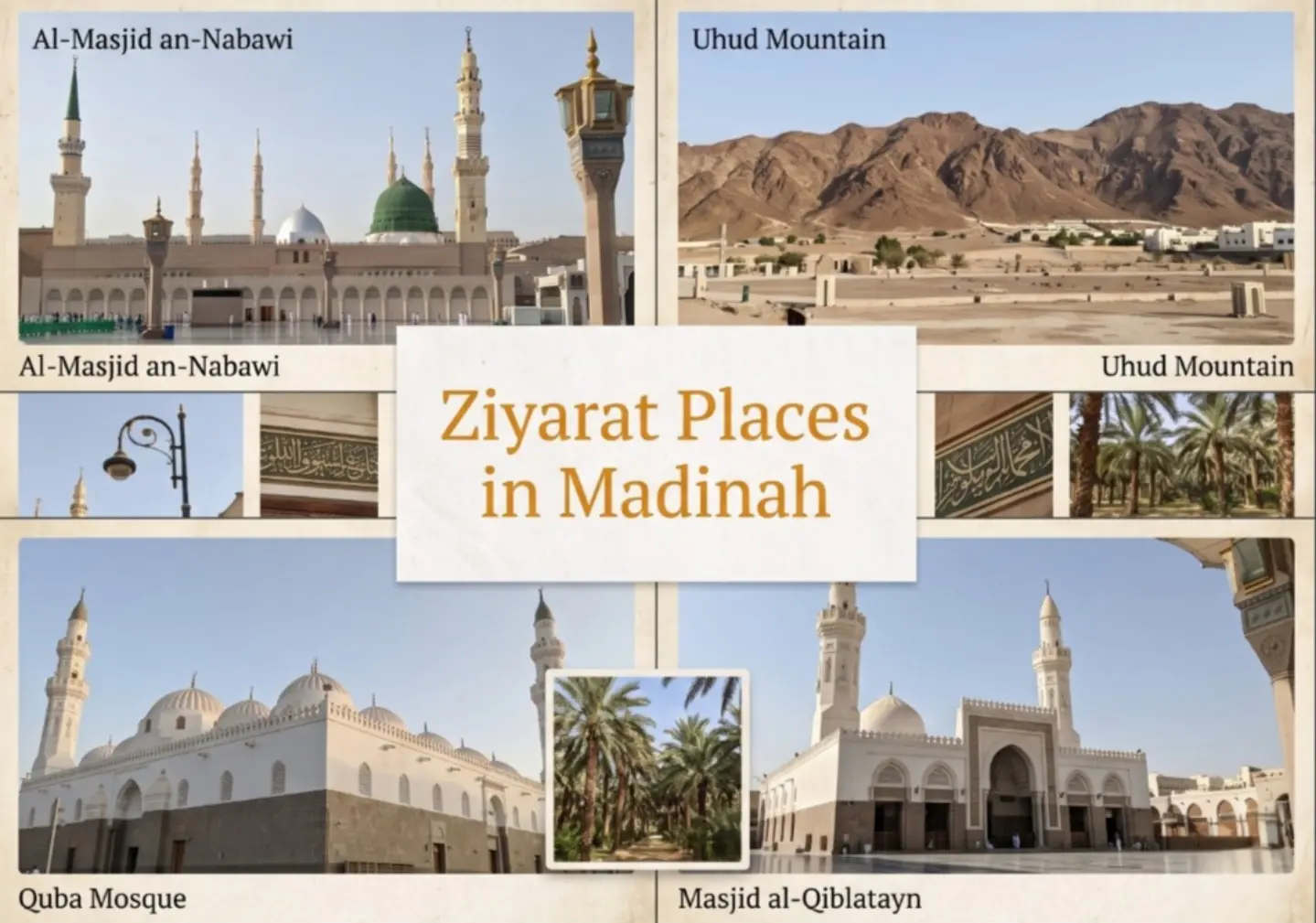

Ziyarat in Madinah means visiting sacred places in Madinah connected to the Prophet Muhammad (peace be upon him), his Companions, and the early years of Islam. The main sites include Masjid al-Nabawi, the Rawdah, Jannat al-Baqi, Masjid Quba, Mount Uhud, Masjid al-Qiblatain, and several other mosques and historical locations. With the right planning, you can cover most of it in two to three focused days.
Ziyarat comes from the Arabic (ziyārah), which simply means “visit”. These sites carry real spiritual weight and bring you physically close to where the Prophet (peace be upon him) lived, prayed, and built the first Muslim community.
Most UK pilgrims land in Madinah knowing they want to “do ziyarat” but have no clear plan for which sites to visit, in what order, or what to actually do when they get there. That gap turns a potentially life-changing few days into a rushed tour. We have put this guide together to fix that.
Masjid al-Nabawi: The Starting Point for Every Pilgrim
Masjid al-Nabawi, the Prophet’s Mosque, is the second holiest mosque in Islam and the burial place of the Prophet Muhammad (peace be upon him). Today it holds over one million worshippers across its prayer halls, courtyards, and surrounding plazas.
One prayer inside Masjid al-Nabawi carries the reward of 1,000 prayers elsewhere, with the sole exception of Masjid al-Haram in Makkah. Narration is recorded in Sahih al-Bukhari and Sahih Muslim. Plan to pray as many salah here as you can.
When you enter, walk the full width of the mosque at least once. You will pass the Green Dome on your right from the main entrance. The tomb of the Prophet (peace be upon him) rests beneath it, next to the graves of Abu Bakr al-Siddiq and Umar ibn al-Khattab (may Allah be pleased with them both).
Sending salaam at the grave: Walk along the eastern section in the designated corridor. Say:
Assalamu alayka ayyuhan-Nabiyyu wa rahmatullahi wa barakatuh
Meaning: “Peace be upon you, O Prophet, and the mercy of Allah and His blessings.”
Keep your voice low, stay calm in the line, and prepare your words before you reach the section. Security moves pilgrims through steadily.
The Rawdah: How to Visit the Garden of Paradise
Inside Masjid al-Nabawi sits one of the most sought-after spots on earth, a small area roughly 22 metres long and 15 metres wide, marked by a distinctive green carpet while the rest of the mosque has a red one. This is Al-Rawdah Al-Sharifah, the Noble Garden.
The Prophet (peace be upon him) said:
Mā bayna baytī wa minbarī rawḍatun min riyāḍil-jannah, wa minbarī ‘alā ḥawḍī
“Between my house and my pulpit is a garden from the gardens of Paradise, and my pulpit is on my cistern.”
Sahih al-Bukhari, Book 20, Hadith 7 (No. 1196) and Sahih Muslim, Hadith 1391
How to book your Rawdah slot in 2026:
In 2026, entry requires a pre-booked permit through the official Nusuk app. No permit, no entry, no exceptions.
- Download the Nusuk app from the Apple App Store or Google Play Store. Confirm the publisher is the Saudi Ministry of Hajj and Umrah before installing.
- Register using your passport details exactly as they appear on your document, plus your Umrah visa number.
- On the home screen, tap “Prophet’s Mosque Services,” then select “Praying in the Noble Rawdah”.
- Choose your gender slot. Men and women have separate entry times entirely.
- Select a green date on the calendar, pick your 30-minute window, and tap “Issue Permit”.
- Screenshot the QR code the moment it appears and save it locally, not just inside the app.
Book this before you leave the UK, not at the hotel, not at the airport. Each person can only book once every 365 days. Morning and late-night slots fill within hours, so check the app three times a day if your preferred date shows no availability. Arrive at Gate 37 (Makkah Gate side) at least 20 minutes before your slot.
Women visiting slot timings differ on Fridays. Check the app the evening before each visit, as Friday windows for women close earlier than on other days.
At a Glance: All Madinah Ziyarat Sites
- Masjid al-Nabawi and the Rawdah
- Jannat al-Baqi cemetery
- Masjid Quba
- Mount Uhud and the Martyrs’ area
- Masjid al-Qiblatain
- Masjid al-Ghamama
- Masjid al-Jumu’ah
- The Seven Mosques (Masajid al-Sab’ah)
- Masjid al-Ijabah
- Bir Uthman (the Well of Uthman)
The sections that follow cover each of these in full detail.
Jannat al-Baqi: Where the Companions of the Prophet Rest
Jannat al-Baqi sits right next to Masjid al-Nabawi, to its southeast. This cemetery holds around 10,000 Companions of the Prophet (peace be upon him), along with his family members, wives, and scholars from the earliest generation of Islam..
Al-Baqi holds Uthman ibn Affan (may Allah be pleased with him), the third Caliph, and several of the Prophet’s wives (may Allah be pleased with them all), among others. The graves are simple, unmarked mounds. No structures, no names on stones. You walk in and feel it immediately.
The Prophet (peace be upon him) regularly visited al-Baqi to make dua for those buried there. A commonly used dua, recorded in Sahih Muslim (Book 11, Hadith 104), when entering a cemetery:
Assalamu alaykum ahl al-diyar min al-mu’minin wal-muslimin, wa inna insha’Allahu bikum lahiqun, nas’alullaha lana wa lakum al-‘afiyah
Meaning: “Peace be upon you, O people of the graves, from among the believers and Muslims. We will, by Allah’s will, join you. We ask Allah for well-being for us and for you.”
What you need to know before visiting:
- Al-Baqi opens twice daily: after Fajr and after Asr, each for roughly 15 to 20 minutes.
- Men may enter through the gates. Current Saudi rules do not permit women inside the cemetery, but they can view and make dua from outside the boundary fence.
- No photographs, no videos, no books, no flags inside the grounds.
- Wear modest clothing. The entrance does not allow shorts or sleeveless tops.
- Be at the gate a few minutes before opening. The crowd builds fast and entry closes quickly.
Masjid Quba: An Umrah Reward in Two Rakahs
Masjid Quba holds a specific, well-sourced distinction. The Prophet (peace be upon him) built this mosque in 622 CE, shortly after his migration to Madinah, making it the first mosque in Islam. He laid its foundations himself.
Sahl ibn Hunayf (may Allah be pleased with him) reported that the Prophet (peace be upon him) said:
Man tatahhara fi baytihi thumma ata masjida Quba’ fasalla fihi salatan, kana lahu ka-ajri ‘Umrah
“Whoever purifies himself in his house, then comes to Masjid Quba and prays one prayer in it, will have a reward like that of Umrah.”
Sunan Ibn Majah, Hadith 1412
And on top of that, Ibn Umar (may Allah be pleased with him) narrated that the Prophet (peace be upon him) used to visit Masjid Quba every Saturday, sometimes on foot and sometimes riding (Sahih al-Bukhari, Book 20, Hadith 54). If your stay in Madinah includes a Saturday, try to visit then. Take your wudu at the hotel before you leave. Make your intention clear in your heart, arrive, and pray two rakahs.
Masjid Quba is 4.4 km from Masjid al-Nabawi and takes about 11 minutes by car. You can also walk the Quba path in 45 to 55 minutes, following the same route the Prophet (peace be upon him) walked regularly. We find the walk itself (particularly in the cooler morning hours) adds a whole different layer to the visit.
Practical tips:
- Take wudu at your hotel, not at the mosque, to fulfil the hadith as stated.
- The mosque is spacious and calm. Far less crowded than Masjid al-Nabawi.
- Next to the mosque is Quba Square, with cafes and rest areas, so plan a short break after.
Mount Uhud: Standing at the Foot of the Martyrs
Mount Uhud stands roughly 5 km north of Masjid al-Nabawi. The Battle of Uhud took place here in 3 AH (625 CE), and the battle claimed the lives of around 70 Companions of the Prophet (peace be upon him).
At the foot of the mountain is the Martyrs’ Cemetery. At its centre lie the graves of Hamza ibn Abd al-Muttalib (may Allah be pleased with him), the Prophet’s uncle, alongside Abdullah ibn Jahsh and Mus’ab ibn Umayr (may Allah be pleased with them). The Prophet (peace be upon him) described Uhud as a mountain that loves the believers and that the believers love (Sahih al-Bukhari, Book 56, Hadith 77).
The grave enclosure is fenced off. You stand outside, send salaam, and make dua. That is what is prescribed, and it is enough.
Practical tips:
- Avoid taking photographs near the graves out of respect for the site and the people around you.
- Your group coach will stop roadside. From there it is a short walk on uneven ground. Wear shoes with good grip.
- Give yourself 30 to 45 minutes here. Many UK pilgrims feel the weight of this place more than they expected, and rushing it is something you will regret.
- Keep your dua prepared before you arrive. The line moves and guards keep things orderly.
Masjid al-Qiblatain: Where the Qiblah Changed Mid-Prayer
Masjid al-Qiblatain, in the northwest of Madinah, marks the exact spot where the direction of prayer changed from Masjid al-Aqsa in Jerusalem to Masjid al-Haram in Makkah. “Qiblatain” means “two qiblahs” in Arabic.
Allah (SWT) commanded this change in Surah al-Baqarah:
Qad nara taqalluba wajhika fis-sama’i falanuwalliyannaka qiblatan tardaha, fawalli wajhaka shatra al-masjid il-haram
“We have certainly seen the turning of your face toward the heaven, and We will surely turn you to a qiblah with which you will be pleased. So turn your face toward al-Masjid al-Haram.”
Surah al-Baqarah, Ayah 144 (2:144)
According to narrations, the Prophet (peace be upon him) was leading a prayer in this very mosque when the command came. He turned to face Makkah mid-salah, and the Companions behind him followed instantly.
There is no specific hadith-based reward recorded for praying here comparable to Masjid Quba. Visit with awareness of what happened in this spot, pray your salah, and let the history of that moment sit with you. A 20 to 30-minute visit is the right amount of time here.
Masjid al-Ghamama: Where Rain Answered a Dua
Masjid al-Ghamama sits a short walk from Masjid al-Nabawi’s western side. “Ghamama” means “cloud” in Arabic, and the name comes directly from what happened here: the Prophet (peace be upon him) led a Salat al-Istisqa (prayer for rain) at this location during a drought in Madinah, and a cloud formed above him as he raised his hands in dua.
Many scholars believe this is the site where the Prophet (peace be upon him) led the Eid prayers in 631 CE, before the growing community moved the practice to Masjid al-Nabawi.
The mosque today is a modest, compact structure. It is not large and not always open for entry, but you can stand outside, appreciate where you are, and offer your salah nearby. Give it 15 to 20 minutes. It is close enough to Masjid al-Nabawi that there is no reason to skip it.
Masjid al-Jumu’ah: Where Friday Prayer Began
Masjid al-Jumu’ah is roughly 6 km from Masjid al-Nabawi, close to Masjid Quba, in the area of Wadi Ranuna. It marks the exact spot where the Prophet (peace be upon him) stopped during his Hijrah (migration) from Makkah and led the first-ever congregational Friday prayer.
Around 100 Companions prayed behind him that day (may Allah be pleased with them all). That single prayer formally established Jumu’ah as a pillar of communal Muslim life. Every Friday prayer you have ever prayed traces back to what happened on this ground.
The mosque can hold 650 worshippers today and is generally open between Fajr and Isha. If your Madinah trip includes a Friday, visiting here before or after Jumu’ah is a meaningful use of that day.
The Seven Mosques: Battle of the Trench in Stone
The Seven Mosques (Al-Masajid al-Sab’ah) is a complex on the western side of Madinah, at the foothills of Mount Sela. Despite the name, the complex today has six mosques, not seven, as two were historically merged.
Each mosque marks a position held by the Prophet (peace be upon him) or a senior Companion during the Battle of the Trench (Ghazwat al-Khandaq, 5 AH / 627 CE), when the Muslims dug a defensive trench around Madinah to repel a combined enemy force. The named mosques in the complex include Masjid al-Fath, Masjid Salman al-Farsi, Masjid Abu Bakr, Masjid Umar, Masjid Ali, and Masjid Fatimah.
Islamqa.info notes there is no specific shar’i evidence to single out these mosques for reward the way Masjid Quba is singled out (islamqa.info, Answer 11669). Visit here for the historical connection, not as an act of specific religious merit. It is worth an hour of your time, and the views of the trench area give real context to what you have read about in Islamic history.
Masjid al-Ijabah: The Mosque of the Answered Dua
Masjid al-Ijabah is a quieter, less-visited site north of Masjid al-Nabawi. “Ijabah” means “answer” or “response,” and the mosque takes its name from what the Prophet (peace be upon him) asked Allah here.
He made three supplications at this spot:
- That his Ummah not be destroyed by widespread famine. Allah granted this.
- That his Ummah not be drowned or destroyed by floods. Allah granted this.
- That his Ummah not be divided against each other in internal conflict and bloodshed. Allah did not grant this third supplication in the same way.
Standing here and reflecting on those three duas, and knowing two were accepted, carries a weight that is hard to describe. Many UK pilgrims say it is the most quietly moving site in Madinah. There is no specific reward hadith attached to praying here, but the connection to the Prophet’s love for his Ummah makes it worth the short detour.
Bir Rumah (Well of Uthman): An Act of Charity Still Remembered
Bir Rumah, also known as the Well of Uthman, sits northwest of Masjid al-Nabawi in a residential area of Madinah. In the early years of the Madinan community, a single well in this area provided fresh water, and its Jewish owner sold access at high prices to the Muslims.
Uthman ibn Affan (may Allah be pleased with him) purchased the well for the Muslim community and made it a free public resource, turning it into one of the most celebrated acts of charitable endowment (waqf) in Islamic history. The Prophet (peace be upon him) is reported to have said that whoever purchased the well would have Paradise as his reward (referenced in Jami’ al-Tirmidhi and Sunan al-Nasa’i).
The site today is a small, fenced area with heritage signage and a garden. Entry is free and generally open during daylight hours. Budget 20 to 30 minutes here, and use the time to reflect on what consistent generosity actually looks like in practice.
Planning Your Ziyarat: Practical Tips for UK Pilgrims
Most Umrah packages in Madinah give you four to six days, which is enough to cover all main sites without feeling rushed, if you plan by zone.
Group your visits by location:
- Day 1: Masjid al-Nabawi, Rawdah (booked via Nusuk before travel), salaam at the grave.
- Day 2: Jannat al-Baqi (after Fajr, men), Masjid Ghamama, Masjid al-Ijabah.
- Day 3: Masjid Quba (take wudu at hotel first), Masjid al-Jumu’ah (nearby), Bir Rumah.
- Day 4: Mount Uhud, Seven Mosques, Masjid al-Qiblatain.
What UK pilgrims consistently get wrong:
- Booking the Rawdah slot on arrival instead of from home. Slots go fast.
- Wearing sandals to Uhud. The ground at the mountain base is uneven.
- Rushing Jannat al-Baqi. The window is only 15 to 20 minutes, so arrive before the gate opens.
- Not taking wudu at the hotel before Masjid Quba, which is specifically how the hadith describes the act.
On the weather: Madinah in summer regularly exceeds 40°C. If you are travelling between June and September, plan outdoor sites like Uhud and the Seven Mosques for early morning, before 8am. Carry a reusable water bottle, wear loose, light clothing, and make sure your footwear covers the full sole.
On modest dress: All ziyarat sites in Madinah require modest dress for men and women. Women should carry a hijab and abaya at all times. Men should avoid shorts at mosque entrances.
(Note: Religious references in this guide have been also checked against Sunnah.com and IslamQA.info for accuracy. This guide is provided by Ziyuf Al Rahman, which also arranges Umrah packages from UK including ziyarat tours.)
————————
Related Articles:
- Important Dates in the Islamic Calendar
- Top 12 Must-See Places in Makkah
- Ihram Guide for UK Muslims
- Best Hotels Near Masjid Al Haram Makkah
- Best Hotels Near Masjid Nabawi in 2026
- Umrah Visa 2026 for UK Residents – Fees, Eligibility & Application Process
- Smart Preparation Guide for Ramadan Umrah 2027 UK
- How to Prevent Heatstroke During Umrah and Hajj
- How to Perform Umrah – Step by Step Guide for UK Muslims
- Roza e Rasool Visiting Time – Latest Rules for Men & Women
- The Main Gates of Masjid Al Haram
- Can You Perform Umrah for the Deceased?
- How to Apply for an Umrah Visa from the UK
- Top 10 Umrah Mubarak Gift Ideas to Welcome Loved Ones Home
- What Is Umrah – Meaning, Rituals & Rules
- How to book a Rawdah appointment