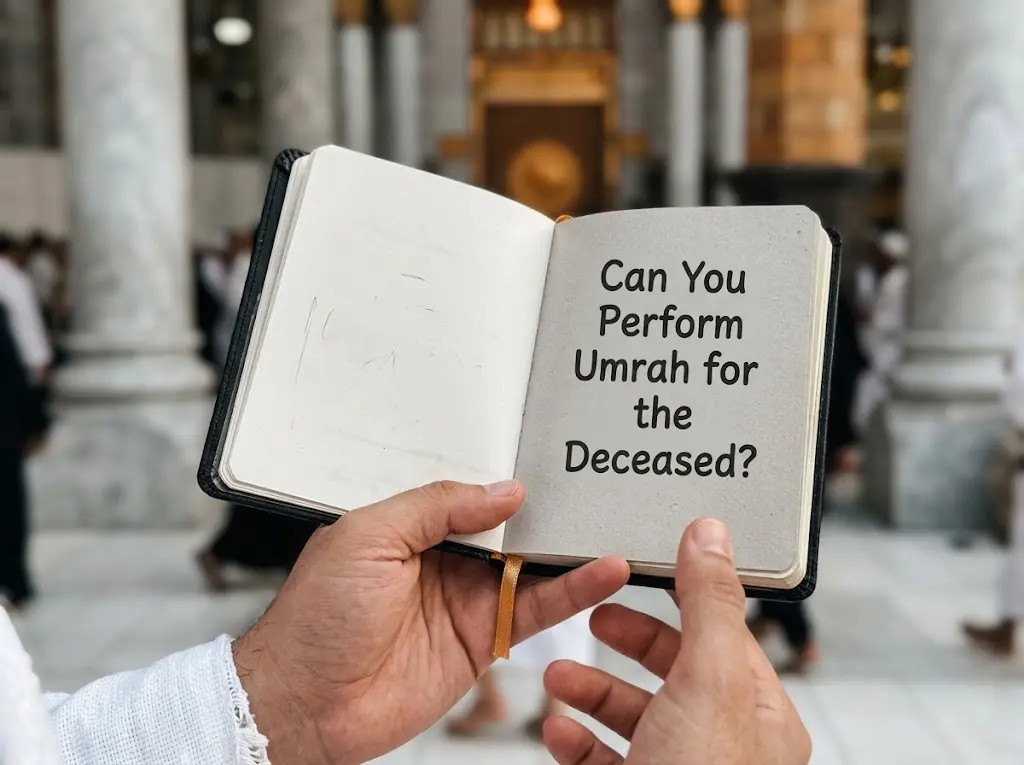

Yes, you can perform Umrah for a deceased Muslim relative through a practice called Umrah Badal, where you or an appointed proxy complete the rites on their behalf. This is widely accepted among mainstream Sunni scholars and brings continuous reward (Sadaqah Jariyah) to the deceased, provided the performer has already completed their own Umrah first.
Losing a parent who never got the chance to visit the Kaaba leaves a specific kind of ache. Many British Muslims carry quiet guilt over a mother or father who passed away before saving enough for Umrah, or a grandparent too frail to travel in their final years. That guilt is common, and it is also unnecessary, because Islam gives you a clear way to act on their behalf.
What Umrah Badal Actually Means
Umrah Badal simply means “Umrah by proxy.” Instead of performing the pilgrimage for yourself, you dedicate the intention (niyyah) to someone else, usually a parent, spouse, or close relative who has died or who is too ill or elderly to travel.
You are not inventing a new ritual here. The steps of Tawaf, Sa’i, and cutting the hair stay exactly the same. The only change is who the intention is made for, right at the start of ihram.
We see families use this most often in three situations: a parent who died before saving up for Umrah, a grandparent with dementia or limited mobility, and siblings who want to send a gift of worship rather than flowers or money at a difficult time.
At a Glance: Umrah Badal Essentials
- What it is: Performing Umrah on behalf of a deceased or incapacitated Muslim.
- Who can do it: Anyone who has already performed their own Umrah, whether family member or hired proxy.
- Islamic standing: Permissible according to the majority of Sunni scholars, with no valid difference among mainstream positions. If you’re unsure which view applies to your situation, we recommend confirming with a local imam or scholar.
- Typical UK cost: From roughly £150 to £400 depending on verification and video proof included.
- Proof you should get: Video or photo documentation of Tawaf, Sa’i, and a completion certificate.
- Reward: Continuous charity (Sadaqah Jariyah) that reaches the deceased directly.
That last point matters more than people realise. The reward is not symbolic. It is a real, ongoing act of charity that Islamic teaching says continues to benefit a person long after they have passed away.
Is Umrah Badal Islamically Permissible?
Yes, you can perform Umrah on behalf of a deceased or incapacitated Muslim. Mainstream Sunni scholarship supports this fully. It is not a modern workaround. It comes straight from the Prophet’s (peace be upon him) own words. IslamQA (Question 142234)
As recorded in Sahih al-Bukhari 1852: a woman from Juhaina asked the Prophet (peace be upon him), “My mother had vowed to perform Hajj but died before performing it. May I perform Hajj on her behalf?” He replied, “Perform Hajj on her behalf. Had there been a debt on your mother, would you have paid it? So pay Allah’s debt, as He has more right to be paid”.
That answer says everything. The Prophet (peace be upon him) compared an unfulfilled Hajj to unpaid debt. You settle a debt whether the person is alive or gone. Scholars apply the exact same logic to Umrah, since the two rituals share so much structure.
A second hadith backs this up. A woman from the tribe of Khath’am asked about her elderly father, too frail to sit on a mount for Hajj. The Prophet (peace be upon him) told her simply, “Yes, you may”. Scholars use this ruling for Umrah too, whenever illness or old age blocks someone from travelling. sunnah.com/bukhari:6228
We hear one worry over and over: does Umrah Badal count less than doing it yourself? It does not. You are settling a debt on someone’s behalf, and a debt paid is a debt cleared.
The Conditions That Actually Matter
1- The proxy should have completed their own Umrah first, before performing it on behalf of someone else.
2- A clear, sincere intention (niyyah) naming the person the reward is intended for, made before entering ihram.
3- Permission from the person, if they are alive. This respects their right over their own act of ibadah.
4- Choose a proxy who is trustworthy and knowledgeable of the rulings, not simply whoever is available. Shaykh Ibn ‘Uthaymin was asked about someone who discovered that the person he’d appointed to do Hajj on his mother’s behalf had also taken on paid appointments for many other families. He ruled that a person should only be entrusted with this task if their religious commitment and knowledge are trusted, and that it is not permissible for someone to accept payment for multiple pilgrimages on the understanding they will perform them personally, only to quietly sub-delegate them to others, this falls under “consuming people’s wealth unlawfully” (Fatawa Ash-Shaykh Ibn ‘Uthaymin, 21/154, as cited in IslamQA 142234).
5- If a proxy does intend to pass the task to someone else, this must be disclosed to the person who commissioned it, since they may not have agreed to that.
While the basic permissibility is broadly agreed upon, some scholars hold that a proxy should ideally have completed their own obligatory Hajj, not only Umrah. Before performing voluntary rites for someone else. If you’re unsure which view applies to your family’s situation, confirm with a local imam or scholar before proceeding.
How Umrah Badal Is Performed
Umrah Badal follows the exact same rites as a normal Umrah. Only the intention changes. Here is how the process runs from start to finish.
- Complete your own Umrah first, if you haven’t already.
- Make your intention for the deceased or the person you’re representing before entering ihram.
- Wear ihram and recite the talbiyah.
- Perform Tawaf: seven circuits around the Kaaba.
- Pray two rak’ahs near Maqam Ibrahim, if possible.
- Perform Sa’i between Safa and Marwah.
- Trim or shave the hair to complete the rites.
- Make dua for the person on whose behalf the Umrah was performed.
Each Umrah Badal requires its own fresh intention and ihram, you cannot perform several for different people back-to-back without re-entering ihram each time.
Who Can Actually Be a Proxy
Almost any adult Muslim who has performed their own Umrah can act as a proxy. Families usually choose one of three routes.
Some send a relative who is already travelling to Makkah for their own Umrah. This person completes their own rites first, then repeats the process for the deceased.
Others hire a scholar or trained proxy through a verified agency. This suits families who cannot travel themselves, whether due to cost, visa issues, or health.
A smaller group combines both, sending one relative to cover two or three deceased family members across separate intentions during the same trip.
Real Scenarios We See Often
A woman in Birmingham recently asked us about her late mother, who saved for years but died six months before her planned trip. Her mother’s Umrah was completed on her behalf within weeks, with full video proof sent back within days of the visit.
Another common case involves an elderly father with dementia, still alive but no longer able to fly. His children arrange Umrah Badal every year instead, treating it as an ongoing gift rather than a one-time act.
You don’t need a complicated story to qualify. A parent who ran out of time, a grandparent too frail to travel, or a sibling who never got the chance, all of these situations fit the same straightforward process above.
What Umrah Badal Actually Costs
Prices for Umrah Badal in the UK typically sit between £150 and £400, depending on the level of verification included (These figures reflect typical UK market rates we’ve observed as a provider and are not from an independent third-party audit; please request an itemised quote for exact pricing). Basic packages cover the rites only. Higher tiers add video proof, a written certificate, and faster turnaround.
Compare that to a full Hajj Badal, which regularly costs over £2,000 once flights, accommodation, and a scholar’s fee are included. Umrah Badal is far more affordable, which is exactly why so many families choose it as a first step.
Cost should never be the only thing you look at. A cheap service with no proof is not a bargain. It’s a risk.
What Proper Verification Looks Like
You should receive three things from any trustworthy Umrah Badal provider:
- Video or photo evidence of Tawaf and Sa’i, timestamped and clearly showing the rites taking place.
- A completion certificate, naming the deceased or relative and the date the Umrah was performed.
- A clear timeline, so you know exactly when the rites were completed rather than guessing.
Ask for these before you pay, not after. A provider who hesitates to promise proof is telling you something important.
Mistakes Families Make Without Realising
We see the same three mistakes again and again.
First, some families skip checking whether the proxy has completed their own Umrah. Without that, the whole act can be invalid.
Second, plenty of people assume one Umrah Badal automatically covers multiple relatives. It doesn’t. Each person needs a separate, distinct intention.
Third, families sometimes pay for the cheapest option available, then get no proof, no certificate, and no way to confirm anything actually happened.
Avoiding all three comes down to one habit: ask questions before you book, not after.
Why This Matters to Us at Ziyuf Al Rahman
The information above is general Islamic guidance, not a fatwa specific to your circumstances. Below is how our team can support you practically if you’d like help arranging an Umrah Badal.
We help UK families arrange Umrah Badal for deceased or incapacitated loved ones, including proxy verification and documentation confirming the rites were completed. Typical UK provider pricing for this service ranges from roughly £150 – £400, though this reflects rates we’ve observed in the market as a provider, not an independent industry audit. Please request an itemised quote for exact costs.
Contact us if you’d like to discuss arranging Umrah Badal for a family member.
————————
Related Articles:
- Best Times to Make Dua During Hajj and Umrah
- How Many Umrahs Can Be Performed in One Day
- Important Dates in the Islamic Calendar
- Top 12 Must-See Places in Makkah
- Planning Umrah in the Christmas Holidays
- Ihram Guide for UK Muslims
- Best Hotels Near Masjid Al Haram Makkah
- Best Hotels Near Masjid Nabawi in 2026
- Complete List of Ziyarat Places in Madinah
- Can a Travel Agency Truly Simplify Your Umrah Pilgrimage?
- How Crowded is Makkah for Umrah in December
- Smart Preparation Guide for Ramadan Umrah 2027 UK
- What to Do on Laylatul Qadr – A Guide for Umrah Pilgrims
- Fasting During Umrah – Key Facts
- How to Prevent Heatstroke During Umrah and Hajj
- How to Perform Umrah – Step by Step Guide for UK Muslims
- Roza e Rasool Visiting Time – Latest Rules for Men & Women
- The Main Gates of Masjid Al Haram
- Hajj Mubarak Gifts
- Step by Step Hajj Guide for first time Pilgrims
- Best Hajj Essential Apps
- How to Spend the Day of Arafah
- Common Mistakes During Hajj
- Difference Between Hajj and Umrah
- How to Apply for an Umrah Visa from the UK
- Miqat points for Umrah from the UK
- Top 10 Umrah Mubarak Gift Ideas to Welcome Loved Ones Home
- How to book a Rawdah appointment